Yukkuri
Yukkuri means slowly. It is also used to convey a message to relax, slow down, chill out. I have heard this expression more in reference to me since we moved here than I have heard in the last year (aside from my mom, who is always encouraging me to do so!). I have been reflecting on this and the ways of the Japanese people. In a previous post, I mentioned watching how they sweep, for instance. They don’t scratch frantically at the ground, they use long strokes. In all their work, they do it well, and take the time required. They are not trying to figure out how to pack as much into a timeframe as possible and hurry on to the next thing. They focus on the here, the now, and do what is needed. It may not be efficient, but if you consider the marvels of everyday life here, it is obvious they’re on to something. The eggs are immaculate and dark orange inside, often double-yoked. The milk is tasty even from a convenience store. The roads are well kept. The cars are all clean. The sidewalks are immaculate. The bread I brought home yesterday had butter cubes somehow baked into it already, in the little holes in the bread. Not in obvious folds. Baffling, and amazing. I could go on and on. Friendships are maintained in a similar fashion, one which we were fortunate to find in our many moves, and in our hockey family. You throw a party and friends bend over backwards to coordinate and bring contributions. Adopt your hens, and build a mansion coop for them? Sure! (Thank you Frank and Ellen! Amazing!) Live with you for two weeks before moving overseas? Sure! (Thank you Arlo and Kumiko! Kumiko, I miss you! And I still wear your lucky socks, Arlo!)

Ben hiking the many stairs up Ogusuyama. Perfect day for a hike to the highest point on Miura Peninsula.
Reflections on slowing down, or at least focusing perhaps a bit more, are timely. I hurt my knee catapulting a pumpkin over Thanksgiving. The fulcrum was too small. And I knew it, but hoped for the best. My knee hyperextended. It felt awful immediately, but I was doing well rehabilitating until two weeks ago. At kendo Ben stopped short in front of me and I swerved to avoid him. I felt something awful in my knee as I twisted. I didn’t stop practicing, though. It hurt, but I could still move. The next day, though, I knew I was in trouble. I had to use a bamboo stick as a cane to walk the kids to school. I could barely get out of bed and use that leg at all. I went to the doctor later in the morning, then physical therapy the next week and long story short I may have torn my ACL, meniscus, one or both. In truth, running feels better than walking. If I stop moving for any amount of time I stiffen up, so better to just keep moving. I’m at least off the Advil, I’m lifting weights to strengthen the joint, and am waiting on a field trip to Yokohama for an MRI on Jan 6. Prayers are welcome 😉

Looking out toward the fish market…
In general I have adapted very well to being extremely careful of who is around me so I don’t have to abruptly turn or twist. But living apprehensively like this is taxing. Last night I recognized while watching a woman scoot across the street that I can’t even really do that without planning it. I can’t jump up and chase the kids. I can’t go from zero to mach 4 anymore. That is a big change. I am far more empathetic to people with limited mobility and how that must affect them moment to moment. I’m very grateful that I can still walk around, but I am fearful of what is next, and how bad it might be. So, contemplating “yukkuri” could not come at a better time.

Today we went for a great hike up Ogusuyama (“yama” means mountain). There is a fantastic view at the top, a spiral staircase to a viewing platform, and even a small noodle shop with an expansive view. We had a great time together despite some grumping from someone who has hiked for nearly 12 years…and who loves noodles. I wonder who that could be. On our way to a fish market at the south end of the peninsula, we made two stops (which I had carefully negotiated to not take too much time, so that we could indeed still hit the fish market in time). First stop went great – care package of American goodies for a friend whose whole family is sick (like 12 lbs of treats – soup, Gushers, Marshmallow Puff, Reeses Puffs cereal, Pop Tarts, Gatorade, etc.). They loved it and it really brightened their day. Then on to stop #2 – the barn where I ride – because the packages for them are bulky and I wanted my friend to have her treat before the New Year holiday. Stop #2 went great. Rubbed horse noses, hid the presents which we’ll open together in early January, and got back in the car, ready to roll on. I chose to go straight on a tiny road instead of turning around with tiny horses, and small children all around (and impaired by the blinding low afternoon sun falling on the dusty windows). So straight we went, up a road I’ve seen little old ladies drive. It soon got very narrow. We thought about turning around, but there really wasn’t a place to do that. We continued on. Dave yelled to get more to the right (driver’s side) but my wheels on the right were already half off the road. I thought he might be over-reacting a tad. It was a very narrow road, but I felt like it was doable in the same manner you point a horse to a jump, give it some firm encouragement, look straight ahead and hope for the best. Assume it will work out, and it usually does. Well, today the universe had a different answer. We heard a pop, and a distinct hiss. Popping sounds are not good. I heard one in my knee a month ago. On a tiny tiny road in the inaka, it is also not good. To our left, I’d bumped into a concrete block that was sticking out a bit. There was a row of them that should have been more like a curb, just brushing the tire, no more harm than some rubbing. But one of them wanted to make more of a point with us. To my right was a small drop-off into immaculate rows of cabbage planted in soft, rich, perfect Japanese soil. That would also have been a deal-ender should we have gone off on the right. Perhaps worse? No way to hoist a minivan back onto the road. So…I’m hoping that you will agree a flat tire is the better option? Please, dear reader?

Anyway, Dave rose mightily to the occasion and figured out where the tire was, wrestled it out from under the car, found the tools and got it changed before I managed to communicate where we were to the roadside assistance people. (Ummm…English please? Sure, I can hold. We were soon on a three-way teleconference. I’ve done this before, twice, from parking lots. “You can’t see the 7/11 on route 214? Ok, let’s start with the Prefecture. We’re in Kanagawa. Can you see Yokosuka? … [directions…directions…translation…searching…] go left. Go 1K and there is a 7/11. Go left. No no, we’re not there at the 7/11. We’re still out in a cabbage field. Go up this little road and take the third right onto a one-lane road. No, a tow truck will not fit back here. You need to send a very clever person in a very small car with a lot of tools…”) My friend’s son was out in his field burning something when I went ahead to check out the rest of the route to see which way we should evacuate. Tetsuya came running back with me and helped Dave loosen the tire bolts. We were soon on our way. But no fish market 🙁

Dave in repose. At last. Sam actually remarked at this view. I agree. Had to capture it.
Dave said on our way home that between the leg and the tire, he thought the universe was telling me something. Sam said “yeah, sit on your butt on the couch and try Playstation!” I had to run (literally) to the commissary tonight for something before they closed at 8pm. I ran swiftly and without pain. I didn’t even realize it was without pain until halfway there, then I marveled at it. I could not believe it. No pain since the flat tire? I think perhaps the universe is saying…patience, trust, but DO step on the gas pedal. It’s ok. It will EVENTUALLY work out. Just yukkuri until it does.
What do you think? Where should we try to go tomorrow? We get three freebies like this in a year with our insurance. SO…we’ve got three remaining!

The best selfie-takers on the planet. Nothing gets in the way. Always ready with a smile. I love you!

Happy Thanksgiving!
Yesterday (11/24) marked exactly three months here in Japan. The family is happy and doing well, and we’ve done so much already to make this home that it feels like we’ve been here a year! Sam is enjoying himself and thinks we made the right decision. Ben is actually on the fence about moving back to the US. Dave is doing well handling the responsibilities. I am deeply appreciative of the daily gifts of exploring the area, developing new friendships, learning the language and a new sport (Kendo), while continuing to work.
Here are a few pictures from today – first Nov snow fall in 54 years!
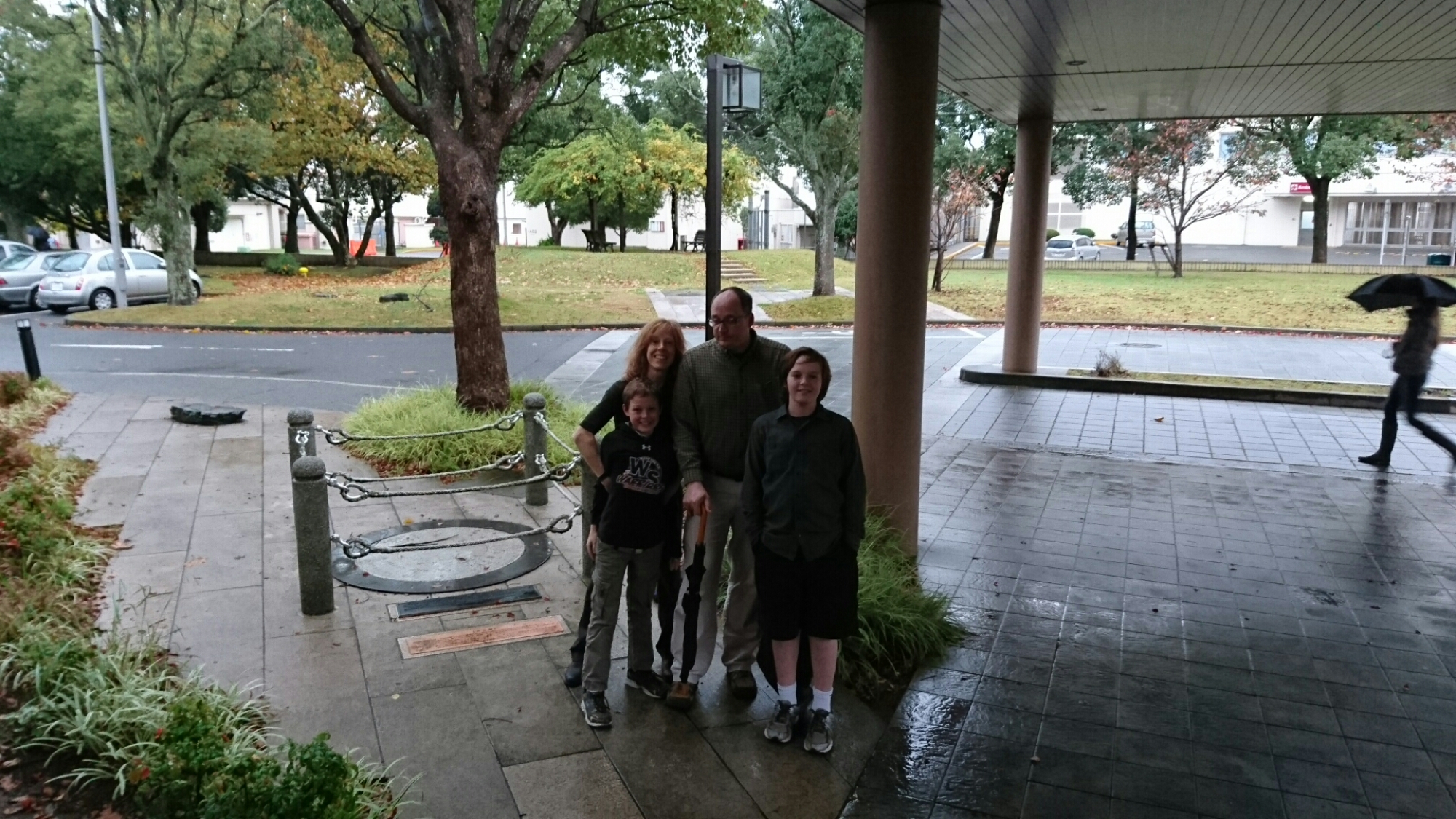
Thanksgiving dinner at the Officers’ Club. We hadn’t eaten there yet so decided a huge buffet was worth checking out. Ben would not stop eating! Usually we have to beg him to finish a few bites of cereal before playing. He and I stock up on holiday food 🙂

I went for a turkey trot in the morning, in the snow, to see the city and the sea. This is Sarushima Island complete engulfed by swift-moving fog (kage – not entirely the right word, but it would do well enough in a broken-Japanese conversation).

Further down toward Hashirimizu the sea was roiling and green (midori umi). Beautiful.
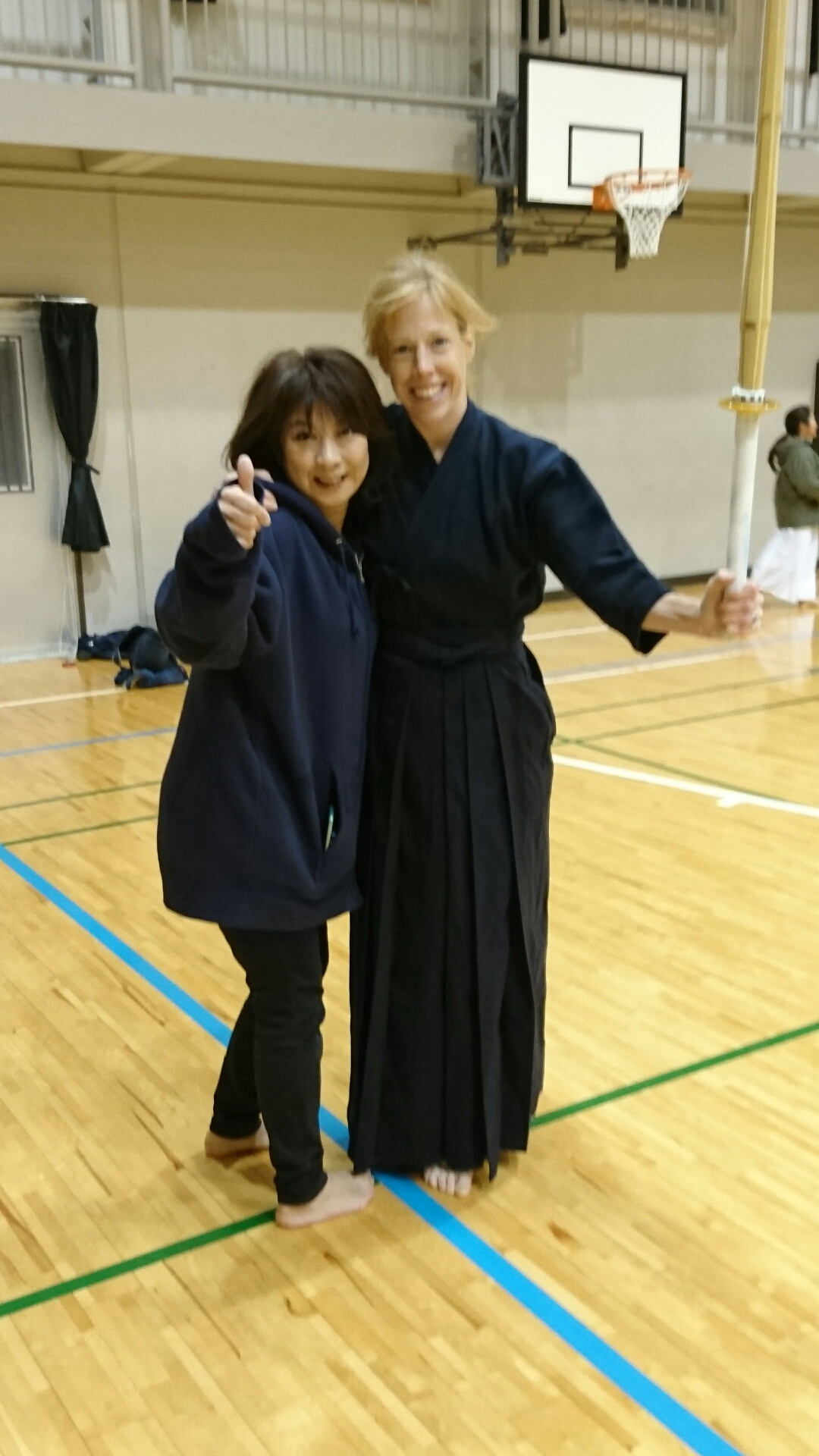
My friend at kendo – Kumiko. She spent hours at a McDonalds helping me order all the gear for Ben and I.
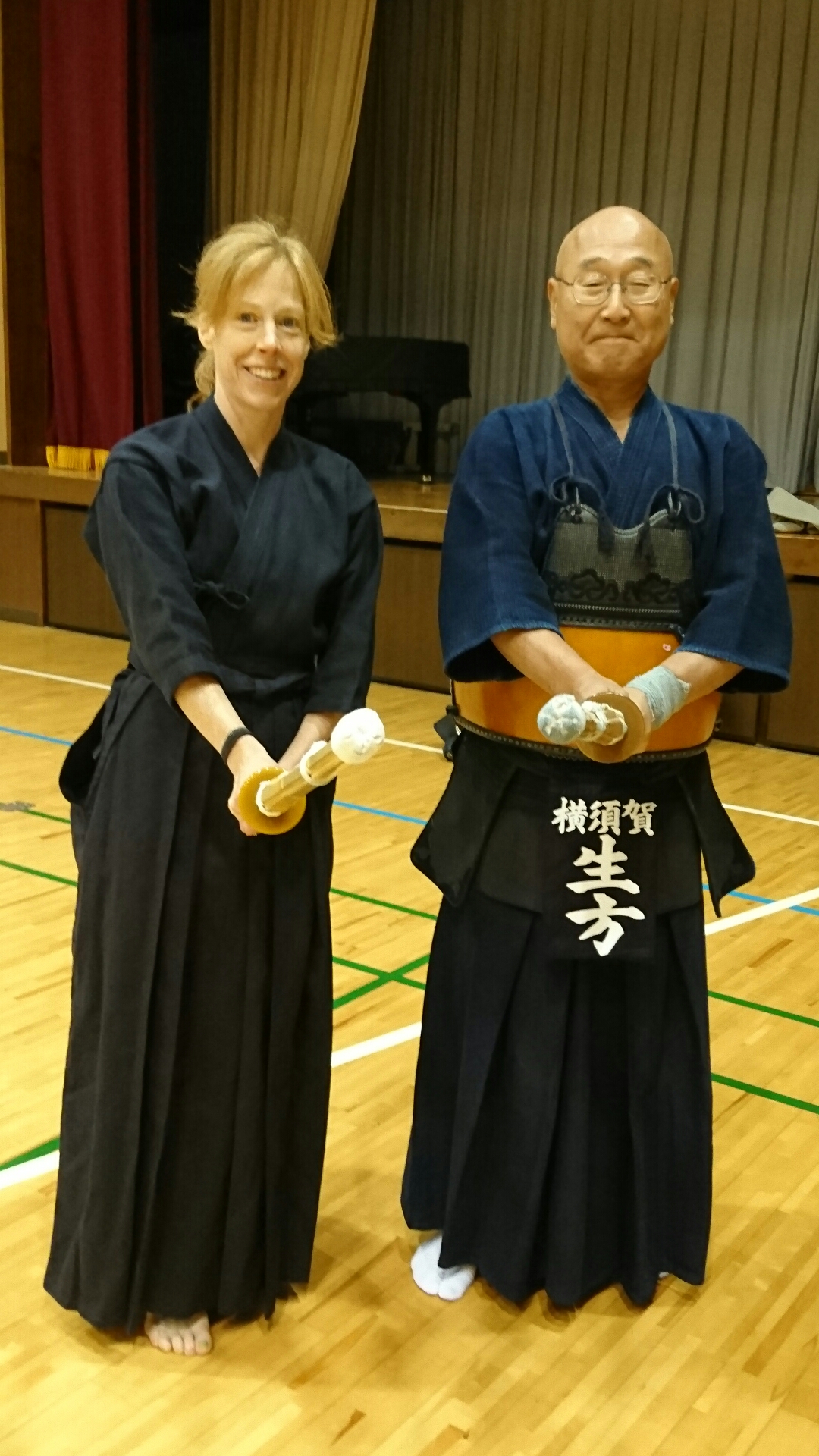
UBUKATA-SENSEI. Our club’s president and a dear man. He is very warm and encouraging. He is a 7 Dan (7th level black belt). You have to hold the belt as many years as the belt number before testing for the next level.
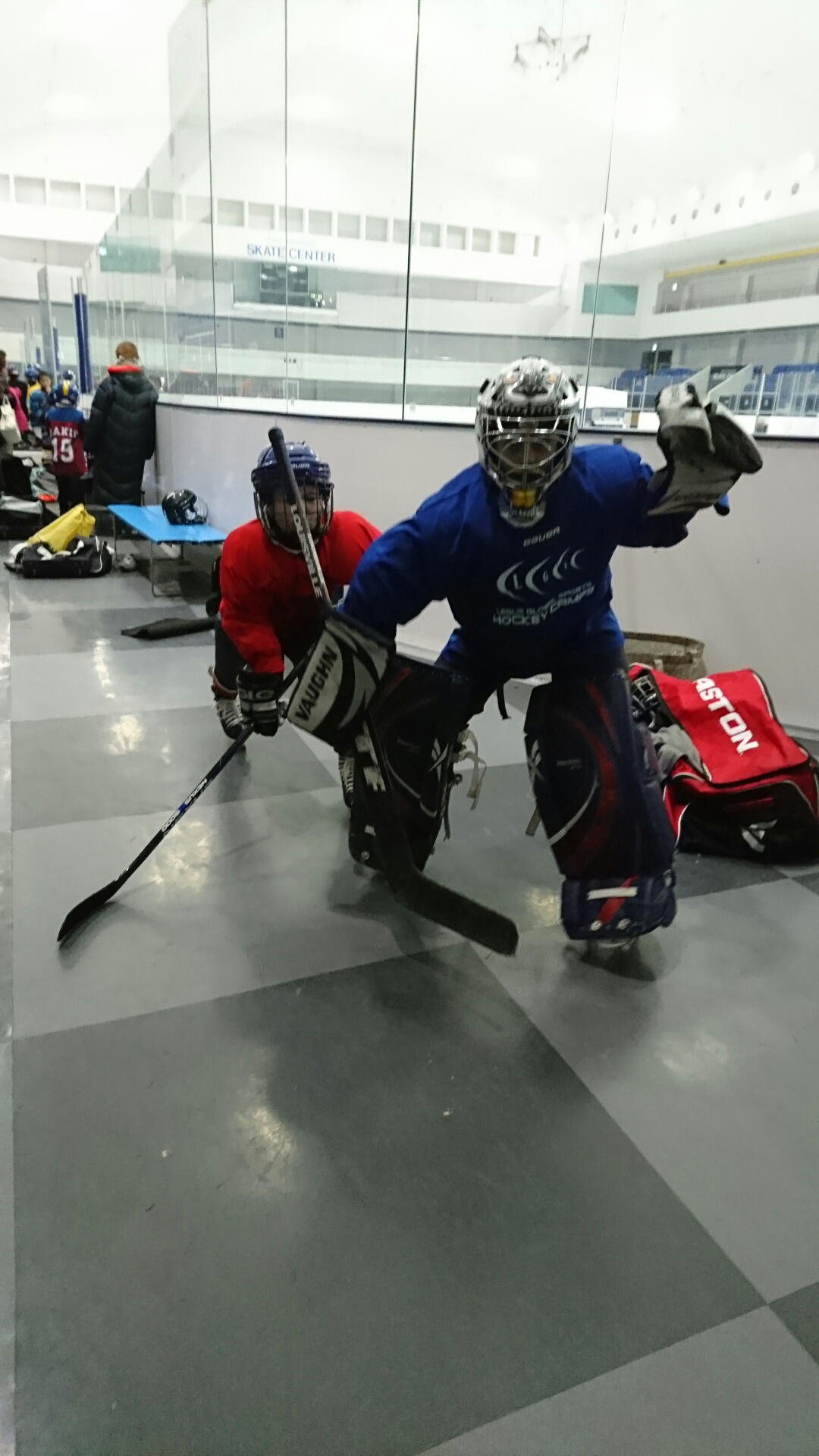
Ben trying out goalie at practice 🙂 His friend Bremerton Jake providing tips.
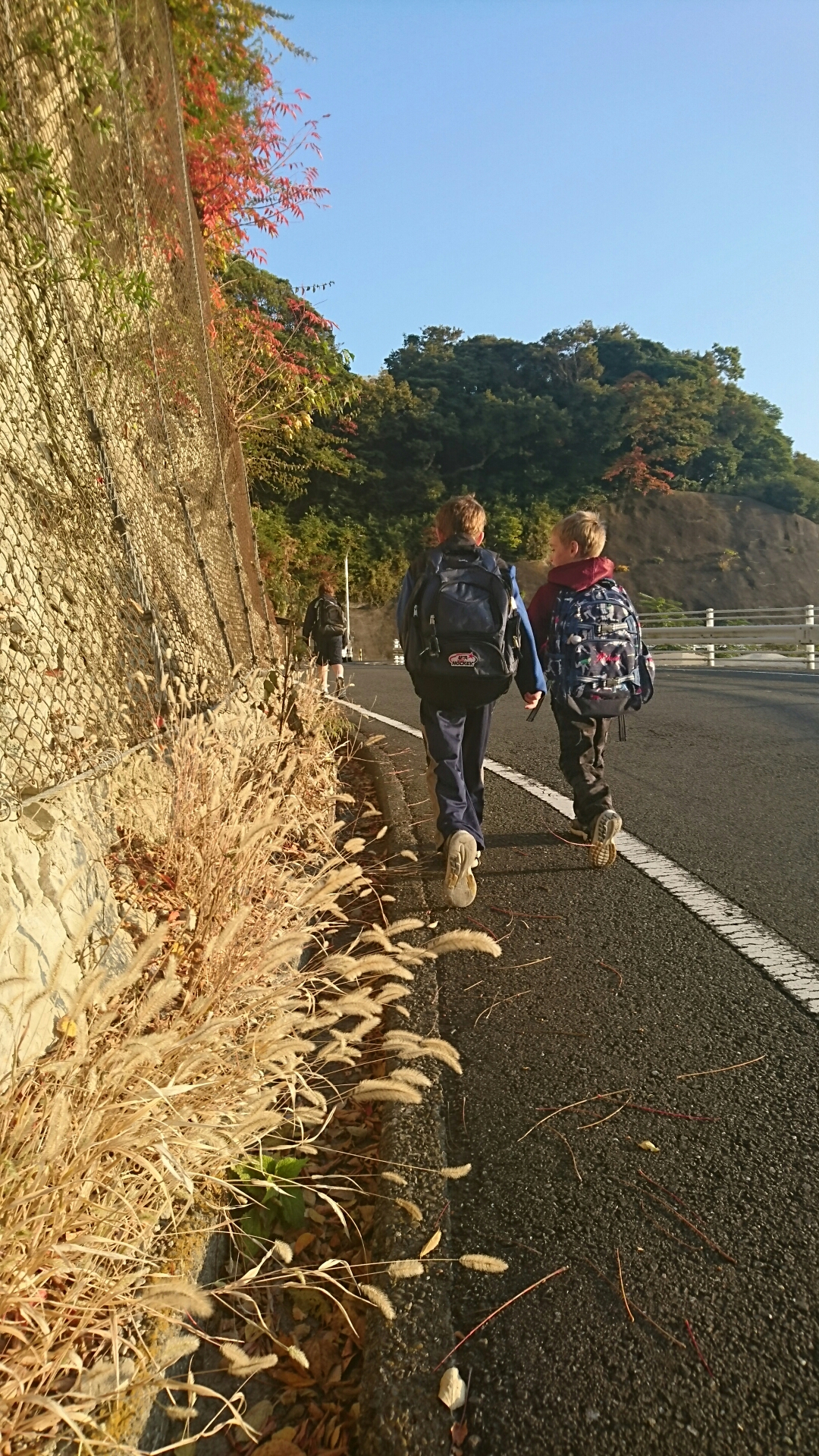
Beautiful walks to school with fall colors and a view of the ocean to our right. This is Ben’s good friend Jackson who lives across the street.
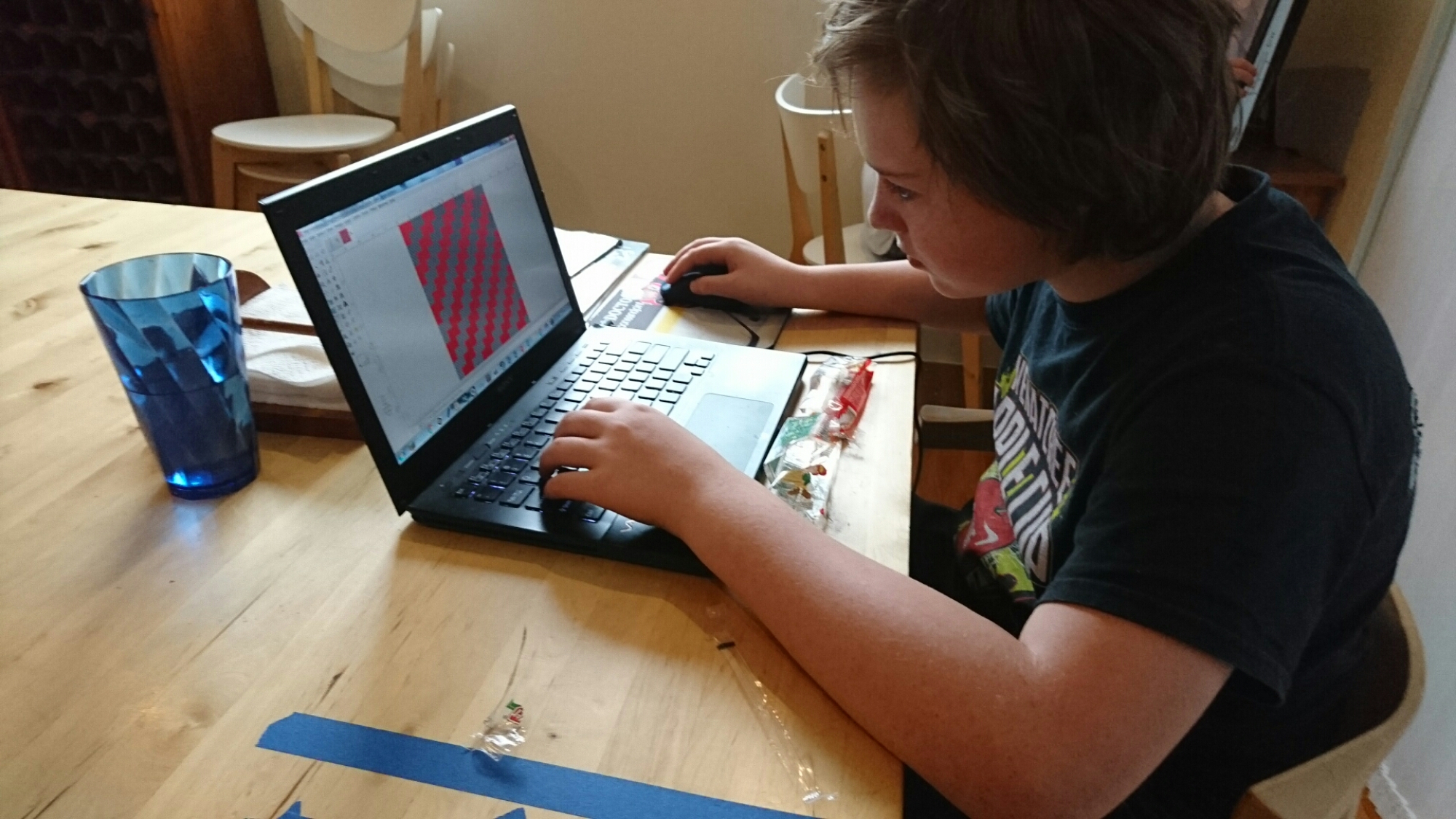
Sam still loves to code. He’s creating a Christmas mod for Minecraft. Lots of generated structures and features!
The boys and I took a group out rock climbing. It was amazing!!!!

Corner climbs are hard but we had good instruction.
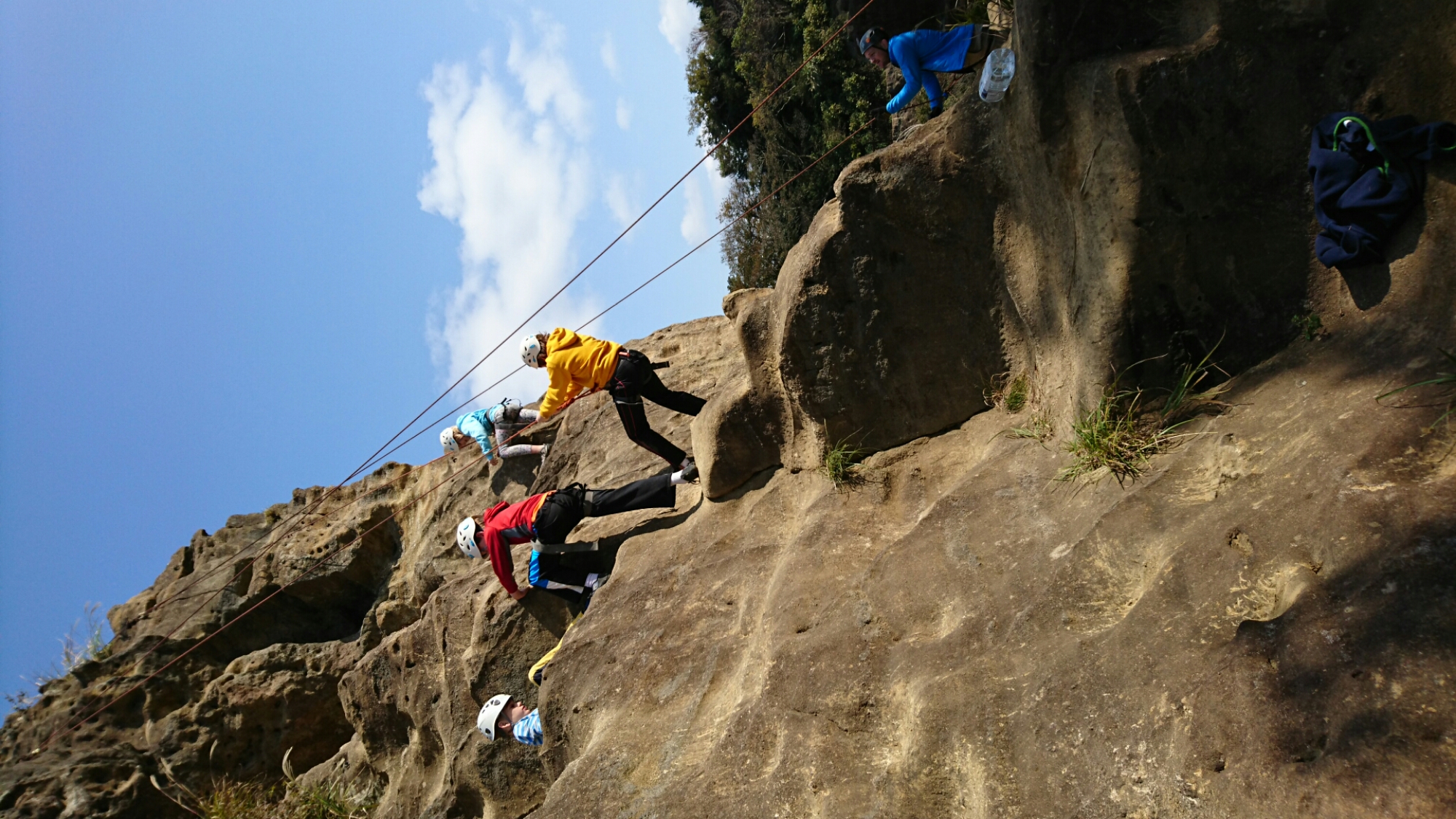
Sam and Ben on the warm up climb.

The neighborhood gang: 8 kids and 3 moms.
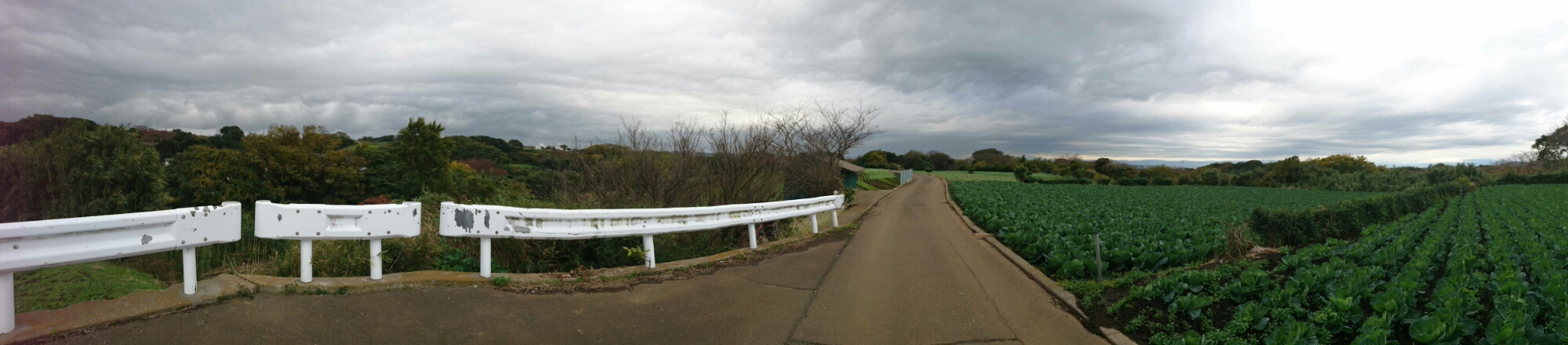
My walk to the barn last week. You probably can’t see it but the clouds parted enough to allow glimpses of distant mountain ranges and the ocean. I think I could see to Korea.
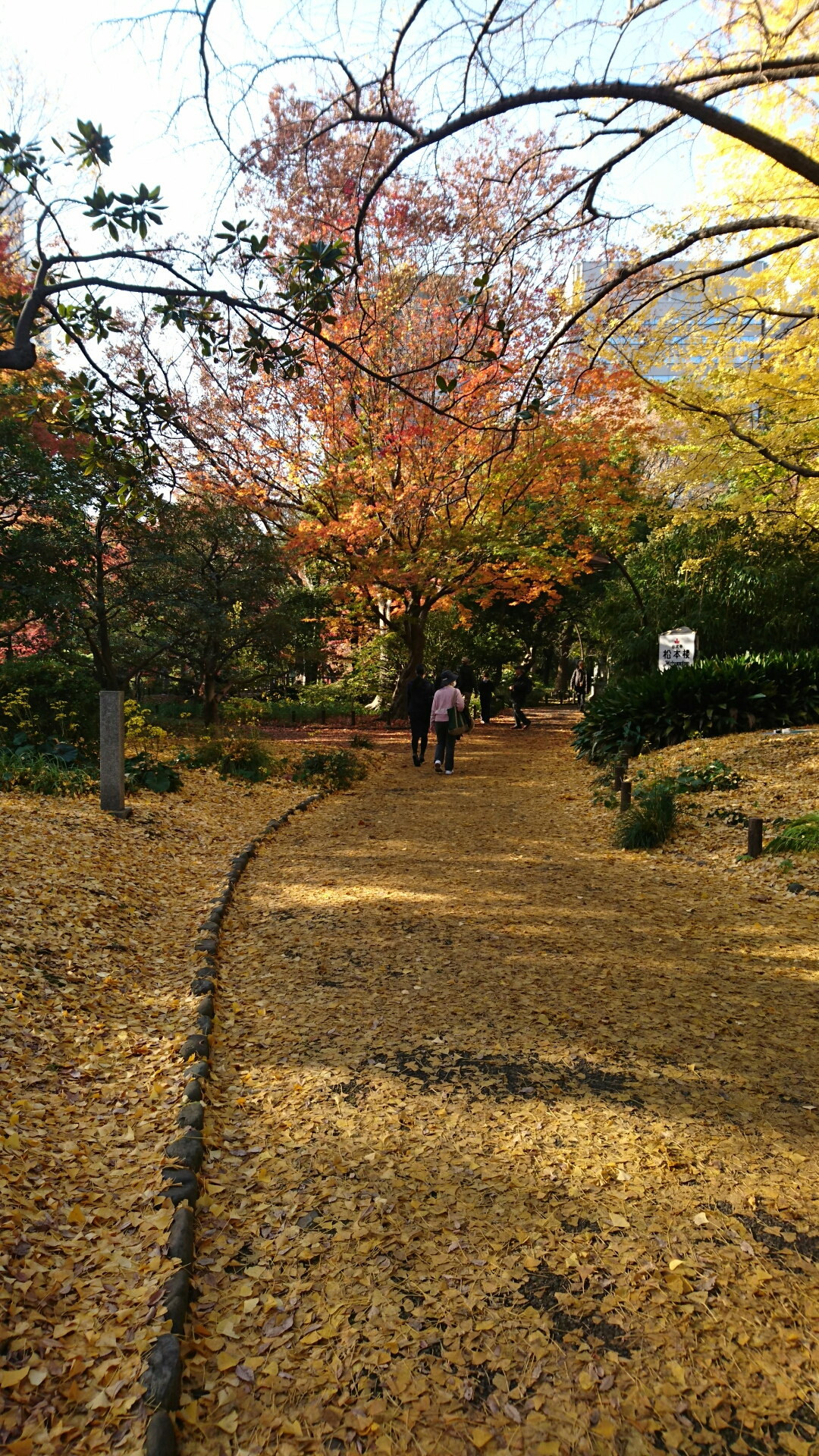
Some pictures of Tokyo today – the Imperial Palace and Hibuya Garden. Trees are in full color. Many beautiful parks for a big city.



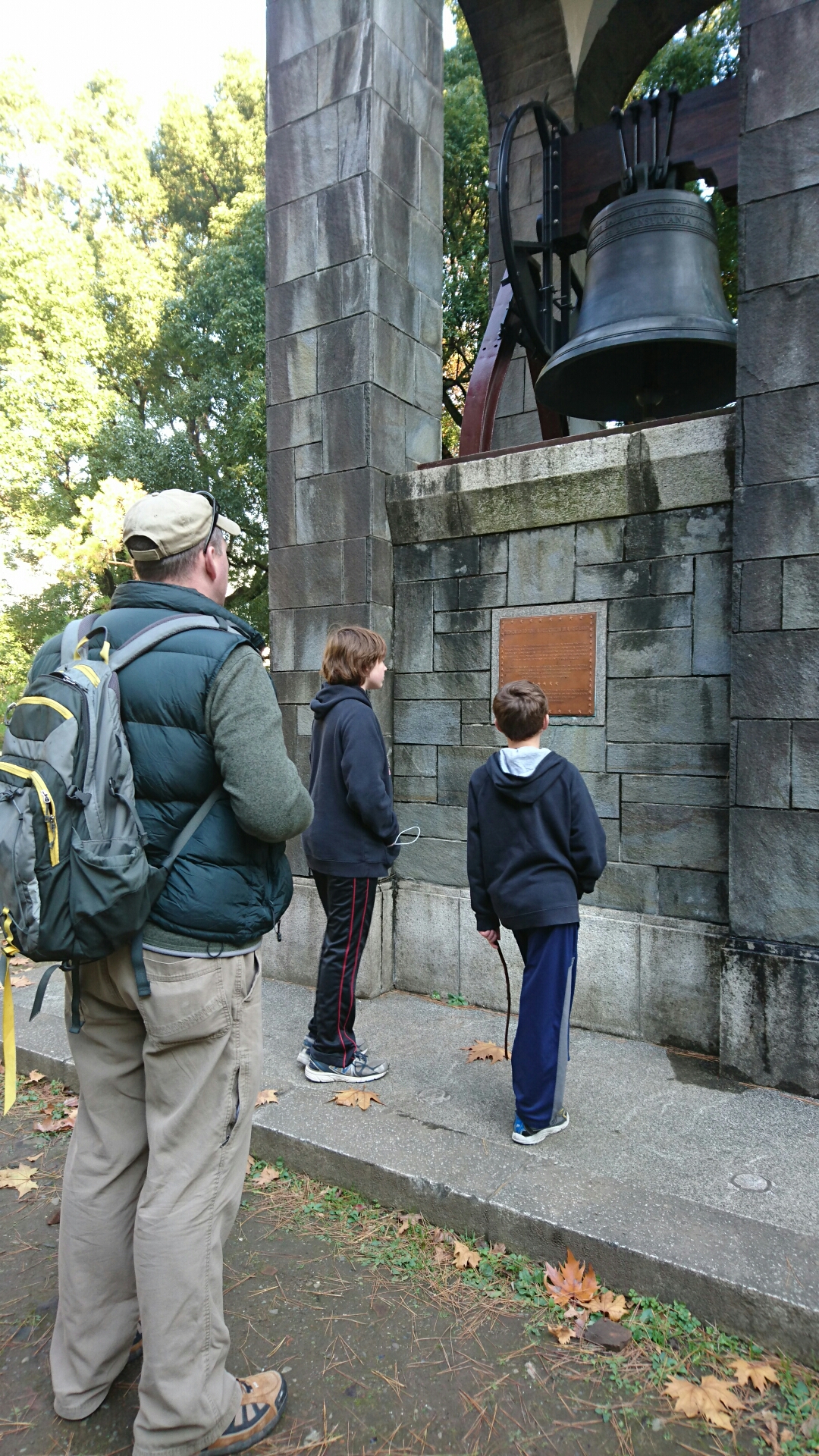
Replica of the Liberty Bell. Gift suggested by General MacArthur.
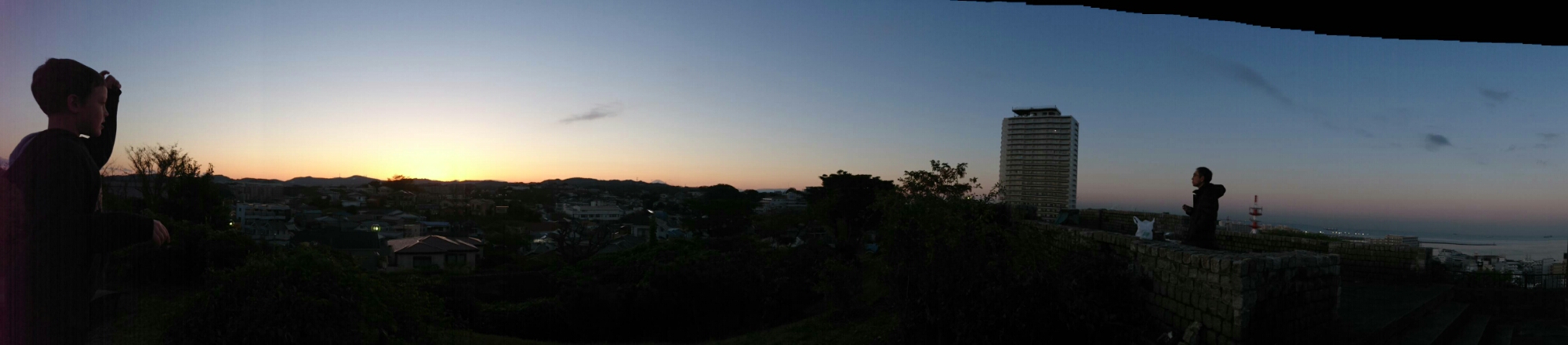
Sunset over Yokosuka. If you zoom into the middle of the shot you can see Mt. Fuji.
No dithering

An entrance to Kinugasa Park which winds its way through a neighborhood then heads up into the park.
I was odds with myself last week, dithering about what I really wanted, and generally languished in a state of perpetual confusion over the weekend. The weather seemed to either reflect my mood, or perhaps – and this would be nice! – perhaps it was at the root of my dithering. It feels like it SHOULD be fall, it’s mid-October. But it’s warm. And the leaves aren’t changing. I feel great unrest with that. Will they be green all year? Or do very few of them change color? Or do they just take flight without ever hailing me with a gold or red wave? I soon remembered that some beautiful maples I have seen come from JAPAN. The Japanese maple. So, indeed, Japanese trees must show their colors. And with that dawning awareness grew a sense of calm that fall is still to come. Perhaps it’s a month delayed here.

A sakura forest which will be gorgeous in spring. I like it at rest. This is in Kinugasa Park.
But with that solved, I realized there are many layers to the dithering, some of which persist… On the one hand I am really craving a long chat with a dear friend to share stories, laugh together, hear about life back in the States, and even savor hearing about old dramas rehashed. But, my success in rapidly and totally immersing myself in the very disparate worlds of hockey, horses and now Kendo, plus work and school commitments, all within precisely two months of the wheels touching down (we landed in Yokota on Aug 24), mean that I have no time at all for such an indulgence. I want to give my best to each of these circles of people who have so generously folded me in. And as an astute reader of these notes pointed out (hi, Gillian!), it is mentally exhausting just going about life in a foreign land. Yes, you could do it in a less exhausting way, but my fear is that if I slowed down, I might just crawl, for a long time. I just can’t get off the proverbial treadmill!

Cabbage field on my way to the farm. This farmer is harvesting little ones, or weeding. I am not sure which. But the mystery of whether the cabbage is planted by human or machine was solved last week. Humans make these neat lines!
There is one area where I am very decisive, though. At the barn. After a couple weeks riding one horse, I have been given the opportunity to try others. I am so very grateful for my days at the barn, and if you’ll indulge me, I’ll close this note with a typical day while the memory is fresh. On Tuesdays, I walk in, drop my backpack full of water, snacks to trade, helmet and half chaps. I find a home for this pack near a tight little circle of chairs around a tiny stove I covet. Like my instructor in Washington, Janet, my host runs a tight ship at her barn. There is a “parking spot” for two wheelbarrows (ichirin-sha) – marked A and B. I grab one and a pitchfork and head to the first stall. Some of them are well lit by the sun and others are pretty dark, depending on whether there are windows or clear corrugated nearby to cast light through dancing dust particles. In the darker stalls I muck by feel. I can tell if it’s super heavy with oshiiko. For those stalls I grab the heavier metal pitchfork because I don’t mess around. That stuff has to come out, now that I know the bedding is gathered up from multiple carpenters and lumberyards (scrap shavings). I was at first really worried about being judicious with the shoveling because bedding can be expensive. I really enjoy using my muscle power to help clean and contribute to this stable. I love being out there, working, and quiet. We can spend quite some time all working side by side, smiling as we pass each other (the owner and some of the other riders who also help out), me listening to Japanese news and music on the radio (many older American songs) and the barn banter. I have watched twice now as the owner and her son treat a horse who has colicked – that is a messy job. But both horses which have fallen ill bounced back quickly. They really seem to know what they’re doing. When the stalls are being mucked, the horses stand nicely in crossties side by side and wait. They also walk back and forth through very narrow spaces between other horses, ichirin-sha and even horse statues and tractors without bouncing around like skittish cats. They have some of the same decorum about them as their owners do. Last week I had the rare opportunity to watch a woman do her dress rehearsal for a side saddle competition. I never in my life thought I’d say this, but I really want to learn. Imagine having only one leg to really guide the horse? It would definitely get me to use the rest of my body more effectively, from seat bones through balance using my core. She looked so very regal in her turquoise hat with black feather, long dress coat and skirt flying in the wind as she and her mount gracefully cantered (kakeashi) around in a circle. Wow. Back to the mucking, cleaning and then riding…

My little rooster friend at the barn! I keep snacks for him on Mondays so I can feed him on Tuesdays. I honestly think he knows to look for me now. He always heads to the front of his little coop when he sees me coming.
From time to time we’ll jot a word down on the chalk board, and this last week I was presented with a picture of a rider on a horse and the word “leverage.” My host had given some thought to what I needed to learn, and chosen the right word. I appreciated her efforts to communicate. She also used the word “pivot.” With her English coming so much more easily now, I am not going to win the race to speak Japanese without concerted effort! I write things on the board that I have learned, like the names of the ladies at the barn, “thank you very much” and other minor expressions, even the hiragana characters. It feels like a frontier school! When done mucking, it’s time to ride.

If you take a picture of a place, then study it later, you notice details previously missed. I didn’t notice the plants hanging from the rafters before. As if there isn’t enough work in a barn already, these are also nurtured along. Amazing place. Janet – I always noticed your planters as I walked Emmy over for a ride. You have an exemplary stable!
When presented with an opportunity to ride a different horse last week, I didn’t really know how to respond. I enjoy the horse I’d gotten to know, I don’t want to inconvenience anyone, and I am not really sure what I’m getting into with a new horse when communication is rather limited. I’ve gotten a few phrases down (switch pitchforks, scrub buckets, water, manure, pee, it’s a nice day, how are you, etc.). But Google translate is HORRIBLE for translating in Japanese. There’s no direct translation for anything. I’ve tried to ask the most basic things at hockey (like “where are the boys?”) and ended up doubled over in laughter after many many attempts to explain that I didn’t see them. Hilarious. Then the pantomiming starts. (Once, the coach and I finally just looked at each other, shrugged, threw our arms wide with a big smile saying “oh well!” and laughed! The boys were clearly somewhere…and it wasn’t important.)

The incredible roller slides at Kannonzaki which would not likely be installed in a public playground in the US!
So, trying to describe the personality and ways of a horse is difficult when I can say just a few basics, such as name-ashi (walk), hayashi (trot), kakeashi, migi (right), hidari (left)…turns out those latter two are pretty helpful, actually. Last week I was told going to migi, fine (thumbs-up), but hidari? Well? The son, who is an excellent rider and trains the horses, gave me a funny look. His expression was something like this – shoulders thrust up, big smile-like grimace, and eyebrows up. I took that to mean, hidari not-so-good! I found out quickly enough – this horse would much prefer to run into a gate or a fence than turn left! The head goes left…but the body? Not so much! I was mounted and dealing with this when my instructor asked – “Want to jump?” This is where the dithering would set in for sure back home in the States. Jump. Now…let me think. Have I warmed up enough for that? It’s been 36 years since I last jumped a horse. Probably not a good idea. I need to get to know this horse better. I need a better seat. Heck, I’m riding in sneakers waiting for paddock boots to arrive. Here, though? No way can I ask any clarifying questions nor even share my internal deliberation.

Ice-cream-sandwich-vending-machine face!
I said “Does she want to?” meaning, the horse. “She likes jumping.” Ok, then. Settled! Jump we did! It went fine. Thankfully, this horse that doesn’t like to turn left did enjoy jumping, and I even got her to kakeashi to the left, and take the jumps. Minor victory. This week I was offered another horse to try, the son’s horse, a gelding. I asked about hidari and migi and got the thumbs up for both, but then noticed a frown growing over the questioning-friendly-grimace-face about water in the arena. I asked if the horse got wild…difficult to translate. So I pantomimed the horse jumping, while holding the reins and got a questioning look, from the horse, too. So I mounted, and trotted over and through the standing water. No big deal. I guess it wasn’t too bad. I’m glad I didn’t know at the time this was the son’s “jumping horse” or I might have thought better of going through what it might consider big water hazards!
No dithering. Not at the barn. Just ride. Right, Analissa??? I think you said that once 🙂
A few more pictures, and a link to where I left off last week, I think…

My new rice cooker being used to bake flatbread. So much fun to have a fire put to good use! I really lamented not having a fire here and it seems that is possible. Not only that…we can cook on it! I love this $50 furnace which a top that holds a rice pot.

A better view of the front. A door opens up, and there are two access places on top for cooking. Pretty neat! I first saw a cast iron one at the barn. Figured I’d start reasonably, and then get a heftier one if I find I can use it. Well…that question was settled immediately upon returning home!

Ben ready for his first tournament! Both boys held their own and did a good job contributing to their teams. Sam had a beauty of a slapshot from the point which found the net!

The broom

Ben’s Halloween decor…very spooky!
As the remnants of our typhoon hit the Northwest, we’re thinking of you all there, hoping you don’t have any damage and really just an opportunity to hunker down a bit. Hoping you are all well. It’s Saturday morning here, we’ve just had pancakes and I have uploaded pictures from the last two weeks. We’re about to head out on a sunny walk – 19 degrees Celsius. I have no idea what temperature that is, but it’s about like Bainbridge was last Wednesday! I have your weather stored on my phone as a favorite.
Dave is back from New York where he spent time with family for 10 days. We are happy to have him home and our prayers are with his dad as life continues with Gail holding him close from above.
Over the intervening two weeks, I have been catching glimpses of character traits in myself that are more Japanese than I might have imagined before moving here. Every Tuesday when I go to the inaka and muck the uma goya, and scrub the bakketo, I think about how much work goes into running a barn. I’m only there twice a week helping to scrub buckets, shovel manure and toss hay, so it’s a treat for me to get dehydrated, dirty and smoky (from the stove’s efforts to dispel flies). But for my new friends who are there every day, it’s another day at the barn, another day of toil. Today, on my walk through the fields of the inaka, the countryside which sets me free from buildings and bustle, I considered how they do it.
The answer lies in watching them sweep. Every broom (hoki – pronounced hoe-kee) I have ever seen is the same – long, stiff, reeds banded together and attached to a stick. They look like this:

photo credit: JapaneseGarden.org
You can’t sweep effectively if you are doing short, vigorous jabs. You have to pace yourself, using long, sweeping motions (that’s where the word comes from, right?). I changed my pace and found it worked better. Things don’t fly around, they are gathered up. After finishing chores and finally seated in a tight circle for barn lunches, I showed my three friends a video of Sam playing hockey, a word I learned early on from Kumiko (pronounced hoke-ay)
They had been amazed we went all the way to Saitama for “hoe-kee”. I was, too! When they looked at the video, though…it was so funny to see their expressions. It was as if they finally understood this sport I had been talking about my boys doing. “Ohhh!” they exclaimed, hands over mouths, eyebrows raised. “Ohhh! Hoe-kay!” Maybe they thought we were all playing broomball? I’ve got to work on my pronunciation!!!
Back to pacing, though. You can’t do a good job if you’re in a hurry to get to the next job, then the next, and the next, before you ultimately just take time for yourself at the end of the day. I tend to line up chores and work end to end, tightly, and go strong until I’m completely done. I end up frantic, spazzy, hungry, cranky. That doesn’t appear to be the way it is done here, and I can now appreciate why. The Japanese people I have met are efficient, careful workers. They are diligent. You can’t really be meticulous unless you pace yourself. I’m a marathon runner, I should know this. Have a plan and stick to it. Don’t go out fast. Run your own plan. Grab the power gels along the way.
Speaking of snacks…

Snack bags. One for Ben. The other for a new friend of mine. One with two legs, crazy “hair,” very long claws, and he crows. It is so nice to have a little friend to save snacks for. I can’t save the volume I used to (it’s just one little roo at the barn) but nice to have some accumulate on my counter.
Here is a little roundup of my ventures out into the inaka this past Tuesday.

I have a new routine down for barn days. Book it from Ben’s school through the gate, off base and to the bus stop by 8am. If I do that I can catch bus 6 and get to the barn by 9am.

Walking a new route to the barn. I loved discovering this route among the fields last week and looked forward to returning.
As I was raking up the hay (which they grow themselves for the horses), I had occasion to to check out the dark brown earth I’d admired from the tiny road earlier in the morning. The ground is well cared for, productive. The soil is very dark and loose, smooth, almost sandy. The cabbage is planted in perfectly neat rows. I figured they were planted by a machine, but maybe not? These observations will feed a conversation about why routines are important, why doing things right the first time matters. I explained to one of my boys tonight that if you do a poor job prepping your mind for a test, then poor output will be expected. You can’t get good stuff out of the (beloved!) vending machine unless you stock it with good stuff. (The vending machines here – OMG!) Janet and Bill (my riding instructors) also refer to the horse’s vending machine. Unclear with your aids? Well, you don’t know what you might get out of the horse’s vending machine.

This looks a bit like taro, doesn’t it? Fields, small ones, right beside what would likely be a dirt road here. Just one lane. People drive down them with vigor, as if they would never expect someone to come the other way. I leap out of the way fast and smile.

I was so surprised to see Fuji-san in the distance today! It’s a lot like Mt. Rainier in that regard. Not always visible. Winter is better for seeing the peak due to the colder air and less haze. I scarf down yogurt just before arriving at the barn. This was a great vantage point for breakfast. Cabbage I think?
Riding around the ring Tuesday, on a quiet older horse which really did not want to do more than walk, I was admittedly jealous of another rider moving quickly with a spry horse. I like harnessing power, and working together with Emmy was a joy. We were often at odds, two energetic beasts with too much going on in our heads, but when we were in unison it was a lovely experience. I should clarify – riding is always a joy. Always. But there’s a certain elusive harmony which keeps those of us who like a challenge coming back for more, and the pursuit itself is a large contributor to the enjoyment. Back to my mount for the day today, Gen, my instructor helped me tune into the minutiae that I often trot right over in my zeal to get “working” – arbitrarily defined by me as trotting and cantering around various ring geometries (although Janet would probably not bestow the term “geometry” on most of my hoofprints). Paying attention to how my balance and the pressure of my seat bones communicates through the back of the horse below me is not something one can rush, nor can an amateur rider really and truly tune into it when other things (like, “ride a proper circle, Alli!”) are pressing concerns. As Gen walked around, carrying me along as I prodded and prodded him, hoping to elicit a hayashi (trot), I enjoyed the view of Fugi-san in the distance, and considered how lucky I am to be immersing myself in the barn life of a new land, hopefully lightening their load a little as they smile at the crazy gaijin’s tales, and knowing that if I am open to it I will learn much from every horse I am blessed to ride. I don’t need to go mach 5… and you know what? The next day I realized you can get a very good workout nudging a horse at a walk…just needed to change my mindset a bit.

A wise old tree accompanied by old friends.

This produce stand…geez. I’ve eyed it for weeks…noting the happy chicken on the sign, making out the letters on the sign as I learn more, noting the hours, and the fields across the street that likely supply it. Each week I look forward to buying local eggs on the way home. AND finding out where the chickens who lay them reside. I got foiled again today! Lights on, but doors didn’t open! I can SEE the eggs!

Here I am dirty, sweaty, thirsty and ready to head home. But buses are inscrutable here. I’ve worked on unraveling this one stop for 3 weeks now. I know at least 4 buses go back to Yokosuka. I can tell that much from studying routes on the web and making out the kanji on the sign. But WHEN? When do they go? You can look at the row for 1300 (the hour I am studying for transit back home) and you tell me when buses going to Yokosuka stop. Even if you could just tell me buses 6 and 8. When do they stop at this bus stop? I asked a professional man in a suit today and he graciously gave it his best effort, even consulting with a sweet older woman with a purple parasol and matching hair. Still a question mark. Take the next one, he said. But when I questioned the driver: “Sumimasen? Yokosuka?” and got a briskly crossed pair of arms in reply…I just stepped back and laughed literally out loud. It is hysterical. I just run to the bus stop, hope to see a line of people, and wait. Then ask, and when I don’t get crossed arms I jump on and watch where it goes! Unlike trains, you can always get off a minute or two later. And I can run for miles…
And a few more shots from just last week…Mom, I know your rump went to sleep looking through five months of pictures last upload, 😉 so if you want to jump to the album where I left off after last week, use this link. Just scroll back a shot or two to make sure I have that timing right.

We survived Takeshita Street! This was on Monday, our day off. We also went to Meiji Jingu Shrine.

I finally got those produce stand eggs on Tuesday! Had to run to catch the bus with them, though! None broke. Is that an Olympic sport?

Checking out Kendo on Thursday – check out the video. This is one intense sport. A combination of hockey (with checking) and sword fighting! Clicking on this photo should take you to the video.


And finally, last night. Making some art and writing in Hiragana with our poker sticks on Friday. Neighbor kids helped by picking up leaves to burn. One of the neighbors decided to celebrate an exam she just took…check out the album for that shot!

Time
I’m not sure how to start this note. I just said goodbye to Dave on the bus, beginning his very long journey back to New York to be with family. We are grieving the loss of his mom, Gail, on Friday. Time is always short, but never more obviously and painfully than when a loved one departs.
I wish I could be there with Dave and his family. They took me in 14 years ago during a very difficult time. Our time together as a huge family – mine and Dave’s together for Thanksgivings on the beach in San Diego, Hawaii, and Washington rain forest fishing trips – is always cherished and is punctuated by hysterically convulsive laughter over something bizarre. I’m smiling now as I type, remembering Bill rubbing his hands together and repeating “our goose is cooked” in Coronado, and now I’m not even sure what he was lamenting? Was it the dog droppings in the grass outside our tiny home? Or me forgetting both turkeys in the sink instead of bringing them to the deep fryer on the beach? And Gail saw a pegasus – an actual pegasus – across the lawn at sunset on Lake Crescent. I will never forget her drawing me aside and whispering…”Alli?! I think that’s a PEGASUS, right?” Generous, kind, gentle soul, Gail, you are deeply missed. I love you. And I miss you.

Nana and PopPop with Sam and Ben at Bloedel.

PopPop enjoyed seeing the Space Needle with the boys 🙂

Nana got right into the chicken tending business!

This one says so many things about what kind of time is important.
But, time has been on my mind as a recurrent theme and challenge for months. The time pressure to accomplish all the tasks necessary for the “hot fill” of our move was tremendous, not to mention maintaining work, family and community commitments, and certainly not least important, investing in friendships and ordering one’s inner world and mind. My life was pretty full already, and it got much more so over the summer and into this fall. It is only now that things are settling into a new routine, and in so doing I’m only just now recognizing how much I value having time to process things.

A run along the seawall, technically off base, but clearly bounded by the sea. A little terrifying to wonder what would happen if a big swell came… I found a way down to this narrow concrete wall, then a spot I could get back in. I carry my ID all the time, but this adventure of zoning out and just going (the term “gypsy run” was coined by my friend Kumiko to describe these sojourns) ended up feeling more like a string of less-than-ideal choices.
Certain activities are more conducive to this sorting and sifting. Running is usually great, but running on base I have found to be too constraining, even on the “wrong side” of the seawall. Oddly, just knowing there is a fence around me tends to hem my thoughts. They can’t bound like deer on Bainbridge, unaware of property lines through the salal. Last week I ran off the base and just kept going south along the coast, through the shopping areas, fish markets, fishing spots, a dragonfly sewage treatment center, and schools, the scents and chimes of Japanese life surrounding me. I figured I’d just go and hop a bus or train back.

In Hashirimizu, looking back toward base in the far background.
The boardwalk in Maborikaigan is wide and inviting. I ran to the end and contemplated turning back, but saw another Japanese runner and figured I’d follow him along his Thursday morning route. I ended up in Hashirimizu, a small coastal fishing village 9K away that is a bit oddly reminiscent of the North Shore of Hawaii. I didn’t realize I was near a park with roller slides the boys will love (Kannonzaki), nor a light house or art museum. I was attracted to the humble park and the bus stop with a queue (always a good sign, adding solid information to the inscrutable bus schedule – it means the bus is coming soon). I rode the bus back for a bit, but wanted to break free again. I jumped off 100yen later and jogged back, looking for the fish market. Back on base, 4 pounds of sweat lighter, I stayed in motion and raked up leaves, discovering a scented flower on a tree. I found out later this tiny orange blossom means fall has arrived. New scents beg to be tinctured…so I bought some cheap vodka at the Exchange. My thoughts continued to run to family and friends, and what this period in our lives is asking of us. In the pool Friday morning I was praying for Gail’s recovery, which seemed promising. I didn’t realize that while I was praying for her, and asking what our purpose should be here, that she had just departed.
Which brings me to the question of time, and what does all this mean. It takes time to discern new missions in life, and we must be open to them. We have to be faithful in listening, and being willing to answer a call even if we are not entirely clear on what that call is. When Dave and I got the call asking us if we’d consider moving to fill this job, we knew right away the answer was yes. What we didn’t know was how we’d manage it, how the kids would respond, how we would come together as a team, and what we would (or perhaps “should” is the better word) focus on while here for this chapter of our lives. Gail and Bill have focused on family and faith. Their example of a simple and steadfast focus is one I admire greatly.
We’ve been here just over a month. In that time we have made significant investments in effort to understand the language, learning three new character sets, ventured out among the people and the land jogging, hiking and shoveling (manure!). These forays help to make foreign skylines and signs more friendly. But there are surely even more substantive investments we’ll make. For now we are grateful for this time to listen and explore together as a family. And we are very thankful for friends Stateside who are willing to stay in touch with us and the kids.
It may not be something you take for granted yet, but do know that we love each of you and our thoughts are with you often as we think about what time it is there, how the kids are doing, how the hockey carpool is going, how the rink is, the friendly faces waiting there to greet us for a game…you are all missed tremendously as we try to assimilate here and fill in those holes in our lives. (This past weekend is an example – we feel like we had a 3-day weekend because we got up at 3am to travel to a hockey game on Sunday! You can get a lot of TIME back in your day if you ignore the clock and travel 4 hours roundtrip, play a hockey game, and get back by noon! ha! 😉 ) Those of you who have been friends in many states and pre-hockey, the same goes for you! As I unpacked pictures of hikes and babies in backpacks, I was happy to see your smiling faces once again on my nightstand, close to me. You are cherished friends. Thank you for being so.
Time…time to get to school and greet my boys! Enjoy these photos from the past 72 hours. More in the album above…

BUT – what does all this mean practically? What can one do with this knowledge? READ THE TOILET PAPER ROLL HOLDERS AT 7/11! I can make out the initial sounds but didn’t know what it meant. I took a picture and showed it to the other hockey parents – apparently this means “Thank you for keeping this place clean” or something like that. I need that here at home…

Ben and I are learning hiragana characters (one of three character sets in Japanese) – and MAN are we competitive! We’re sitting outside Purdy Gym on Friday exclaiming to each other as we use an app to learn (% proficiency creeping up with each correct answer). He’s a very fast learner. Kumiko was awake in her bed while we were learning so we pestered her with amateur attempts to say “where is Arlo?” or some such 😉 Thanks, Kumiko! 🙂

Here we are today – Sunday 10/2 – walking to the Saitama Ageo Sports Park for a hockey game. The dry land started at 0600…so we had to get up at 3:10 this morning. OMG. This is after driving up to Yokohama and back on Sat evening for practice. Kind of one of those weekends you gut through to check it out, if not to make every future weekend rather pale in comparison. It won’t likely be much more grueling than this… right? 😉 We like to dive deep. ;0

But the payoff? Sam getting to actually play a game with his team and show his coaches what he can do. A rainbow, which evolved into something even more astounding…

A double – and some said triple – rainbow! New hockey friends and boys having a good time exploring their new land. This rainbow made me think of a similar image of Bremerton.

The game against the Saitama Warriors (what!? really? I had to zip up my jacket quick to cover up my WSHC Warriors gear!) went well – we won 8-3. Sam held his own and was very happy to play. Many videos are in the album.

This is our lawn, looking toward the rest of the cul de sac. The house just past ours has a hockey dad from NJ in it! Amazing!

This is me and Hayashi-san, the team manager for the A (select) team. We swapped favorite snacks this weekend – I was thanking her for all she does for the team. I well know what it’s like to roll in four new players – new jerseys, socks, rosters for tournaments, payments, questions, etc. etc. She brought me Hokkaido corn. Hokkaido is the northern island and hockey (all snow sports) are big there. She is a very energetic and happy lady. You can hear her voice easily calling out through the rink!

We are on our way back home now. Shockingly – back by noon and already up 9 hours with a hockey game and 4 hrs driving under our belts.

Time to make eggs, wash gear, catch a cat nap and occupy a bustling neighborhood of kids with yard work for yen! (Money really DOES grow on trees for them!)
“home”
It didn’t really hit home (ha!) that our new house is now our home until I was sitting in the stands last night with two new Japanese lady friends (fellow hockey moms) and needed to tell Google maps that my “home” address is not on Day Road any longer. Google just has one option for HOME. I wish it could have other options, such as “HOME FOR NOW” and maybe “HOME FOR GOOD”? We have a small plaque that says “Home is where the Navy sends me”, which is true, but only on the surface. It is still possible to develop deep attachments to a place and its people, the rhythms and scents of its seasons, the profiles of its peaks, the heaviness of the air, the clarity of the sky, the sweeping of its clouds and the length of its days. While I wouldn’t say we are anywhere close to developing deep attachments here yet – it’s only been 25 days since we went through customs – I can see how one would very quickly. And I wish I had more space – literally and emotionally – to adequately distill my impressions, but to start I would say the graciousness of the people and the overall courtesy which defines the culture are captivating. If one immerses oneself in the new land, it is a delight to find yourself beginning to adopt these gentler ways and be rather surprised when fellow creatures from the States act in their usual manner upon departing a yoga class…barreling to the door instead of yielding. (Of all places, right? No sooner than the final “namaste” was uttered…)

The entry to our house under a full moon.
This was a very very busy week and weekend. We got our keys on Monday the 12th. Household goods arrived Tues, Wed and Thurs (two different shipments). Boxes exploded all over, stuff piled high on counters, chaos in full pursuit of our sanity. No food in the house because you can’t even get the fridge open 😉 But I am very impressed with how much we’ve wrangled. Concerted effort on Thursday had the kitchen functional by about 9pm, even with a break to introduce myself to neighbors and keep an eye on pucks flying toward the goalie net 😉 Not a lot of space here for mistakes (!!!). Friday saw the boys’ room and the master bedroom begin to take shape. Saturday and Sunday were spent shuttling things all over, creating donation piles and setting up dining, living and office spaces. Dave did a masterful job hanging pictures and decor, and setting up the media so we have a place to relax together as a family. I’ll give a tour hopefully at the end of this week, but a few pictures in the album will give you a sense of the place. My perch for work (and typing right now) looks out over the side yard which is our entryway. I have trees and grass – lots of green – through the wall of windows in the little atrium off the kitchen. I’m in the thick of things, but not in the way, and aware of what is shakin’ out on the cul de sac. A good vantage point. The neighborhood is FULL of kids! It’s so amazing! The boys are really enjoying new friends and Sam is walking all over base hatching Pokemon eggs. This morning he got a Charmander.

The kitchen comes to life!
The highlight of the boys’ week was this weekend – finally getting to skate with the Japanese hockey club. There are four age groups, and our boys are in the younger two (lower grades – 1, 2, 3; and upper grades – 4, 5, 6). About 20 kids play on both teams, and they practice together, sharing the large Olympic-size ice sheet. You’ll see many videos of drills and the video from yesterday (9/18) shows some clips of a game the upper grades A team (their select team) played against the best team from Tokyo. We have been impressed with the intensity of play, the focus during drills and sustained focus throughout a straight 90 min of practice which doesn’t have more than 1 or 2 quick breaks. Another impression of Japanese people so far – intense, focused, strong work ethic, efficient. Don’t unclip your mask – shoot water in and go back to the drill! This holds true for the youngest kids as well. No flopping around on the ice complaining or whining… The coaches are friendly, many speak English, and all played hockey in college. Sam and Ben are very happy with the serious approach and their teammates. About 7 kids on Sam’s team speak English – parents are expats or married a Japanese spouse. It’s more expensive for sure ($1600 not including tournaments (there’s 4-5 a year) and the kids must buy jersey, blue breezers, blue helmet and hockey socks to match. Practice is only on weekend evenings so that somewhat dominates our weekends, but I guess hockey dominates weekends anyway, right? 😉 On the plus side we get to travel with this delightful group and learn about Japan through a familiar culture – hockey. The kids extend their base of experience and continue building skill in a game they really love. They are so happy to be on the ice – don’t miss the movie of Sam talking about his first practice (9/17).

Practice for lower and upper grades.

Tyler, Sam and Issei – one of their coaches! They learned “sho-gu!” means come here to listen to the next drill! The link attached to this picture takes you to an interview with Sam 🙂
The highlight of Dave’s week? Probably getting music playing capability set up, and navigating the car up to Yokohama successfully for ice hockey! It’s no joke driving here. People regularly drive 20K above the speed limit. He did a fantastic job paying tolls and dealing with a ridiculous under-the-train-tracks-single-lane-hairpin… I, however, am not relaxing to ride with. I have zero self confidence driving in a city here. Put me on Scottish roads with a stick shift and sheep PLEASE! That was no problem…I’ll get it, though. I also drove the roundtrip yesterday. We’re all fine. ;0
The highlight of my week was finding a barn and a horse to ride! After much searching and disappointment, and the help of a kind translator, I found a barn about 5 miles away (an HOUR by bus and walking!) where I am now regularly volunteering my muscle to help clean stalls and scrub water buckets with the proprietor and her husband in exchange for riding. Language is a challenge, but one can quickly catch on to barn routines by watching carefully, smiling, asking, pointing, and even drawing on my handy whiteboard (yes, I got a small whiteboard to help me communicate – I take it everywhere! and old-school tablet!). My knees weakened a bit when I was shown my mount with this introduction “she is young four years; feet quick; first time out.” I was thinking WHAT?! First time out…today?…this week?…EVER? I nearly said maybe not…but then figured ok, I’ve been on interesting horses before. Read the horse, groom it, get to know it a bit, give it some scratches and kindness, get on, and see how it goes. One foot in front of the other. All did go well, and I enjoyed myself very much in borrowed helmet and half-chaps. I now have my own boots and helmet, and venture out again tomorrow. This time I can figure out the bus schedules (NOTHING in English on those babies! Trains are far more gaijin-friendly.) Last week trying to find my way back was fun – I played some informal chase with a group of young Japanese students (maybe 10 or 11 years old?). I asked for help, we couldn’t communicate well, I gave up, kept walking the direction they pointed, looked back, smiled, then jogged on (needed to get back to base asap to get Ben from school), heard little feet jogging behind me, stopped quickly and turned around with a big smile, surprised them, they smiled as they came to a stop, then we all took up the game again for a few blocks. Kids are kids anywhere. I wonder what they told their parents that night. I was kinda in the middle of nowhere, but still in the middle of everywhere. Very urban but with large fields all around. By the way, you’ll see pictures of this, but the lady who owns the barn works very very hard. She actually grows hay and takes a wheelbarrow out at lunch time to cut hay and bring it back. Everything takes longer. You can’t be in a rush and run a barn that way. They burn cedar shavings in a small stove to keep the flies at bay. I’ll never forget walking into the barn and seeing the sun streaming through the clear corrugated plastic ceiling, catching all the dust like little stars, and the smoke filtering up in the stream of light. It was enchanting.

Janet and Annalissa! Kris and Kristine! I rode! I did! It took two weeks to find a horse but that’s not bad! Dave thought it would take three months. I felt like it would, too. I miss you guys, though! Please say hi to Emmy for me. Tell her I’ll work on my technique so I’m not such a fool when I return 😉
To wind down from all this excitement I use “Kanji Study” which is the most fantastic free app I have EVER seen. You can practice drawing kanji with help – little guides which you can turn on and off. There are also little videos for each kanji and many descriptions of usage. It is just out of this world. You might have fun trying it? Maybe? The best one is for Android. The drawing practice doesn’t seem to be built into the iPhone version.



We ALL miss our friends back home (see? still calling Bainbridge home) and really hope to get the technology to help us out here. I am enjoying the app LINE very much. It provides the ability to send texts, pictures, video and audio messages and even calls. It’s very clear, easy to use and no wonder so many people here use it. If you’d be willing to download it, look for me. If you don’t find me easily, shoot me an email and I’ll give you my ID. They kids are using Skype to text and send video. It also works well but the video quality is much grainier and I feel like the app is not as intuitive. Give LINE a try? Sam and Ben would LOVE to connect with your kids. Weekends are good – Sat morning here is your Friday afternoon there on the west coast (16 hours behind us). East Coast family – you’re 13 hours behind us.
Ok…as luck would have it, I am also busy with work right now as well and was manic this weekend fitting in deadlines and unboxing. My faith-based business model dictates that I will be given the grace to manage all the work that comes my way, whenever it comes. So…pray for me! 😉
All my love to each of you. Know that as I unpack pictures of friends, hikes had with babes in our packs, I have tears in my eyes. I miss you very much and am thankful for each of you. And I need to print out more pictures to hang around me! Phone is not enough 🙂 Please send me a note and let me know how you are.
matane
Whew! What a week!
Just a quick note this Friday – it’s 5pm in Yokosuka (actually it’s now 9:30pm Saturday) and I’ve been thinking of you family and friends often. After more than 24 hrs in transit, starting at midnight with a reverse-Cinderella departure by large black Suburban, we arrived in Yokosuka on Wed 8/24 at 4:44 in the afternoon. Every minute since has been occupied with getting checked in – area brief every day for Dave and I, kids registered in school, laundry, ramen slurped, homework done, to-do list tackled…(I had to find a special to-do list app to stay synced with my 27 tasks!). Despite the busy-ness and the “OMG did we seriously just move to Japan?” moment two nights ago we are all doing very very well and taking every advantage of this beautiful and unique place. This weekend I’ll try to get pictures of the summer, baby chicks and camping during hockey camp in British Columbia up but wanted to share a quick hello to let you know you’re missed! Here are some snapshots…
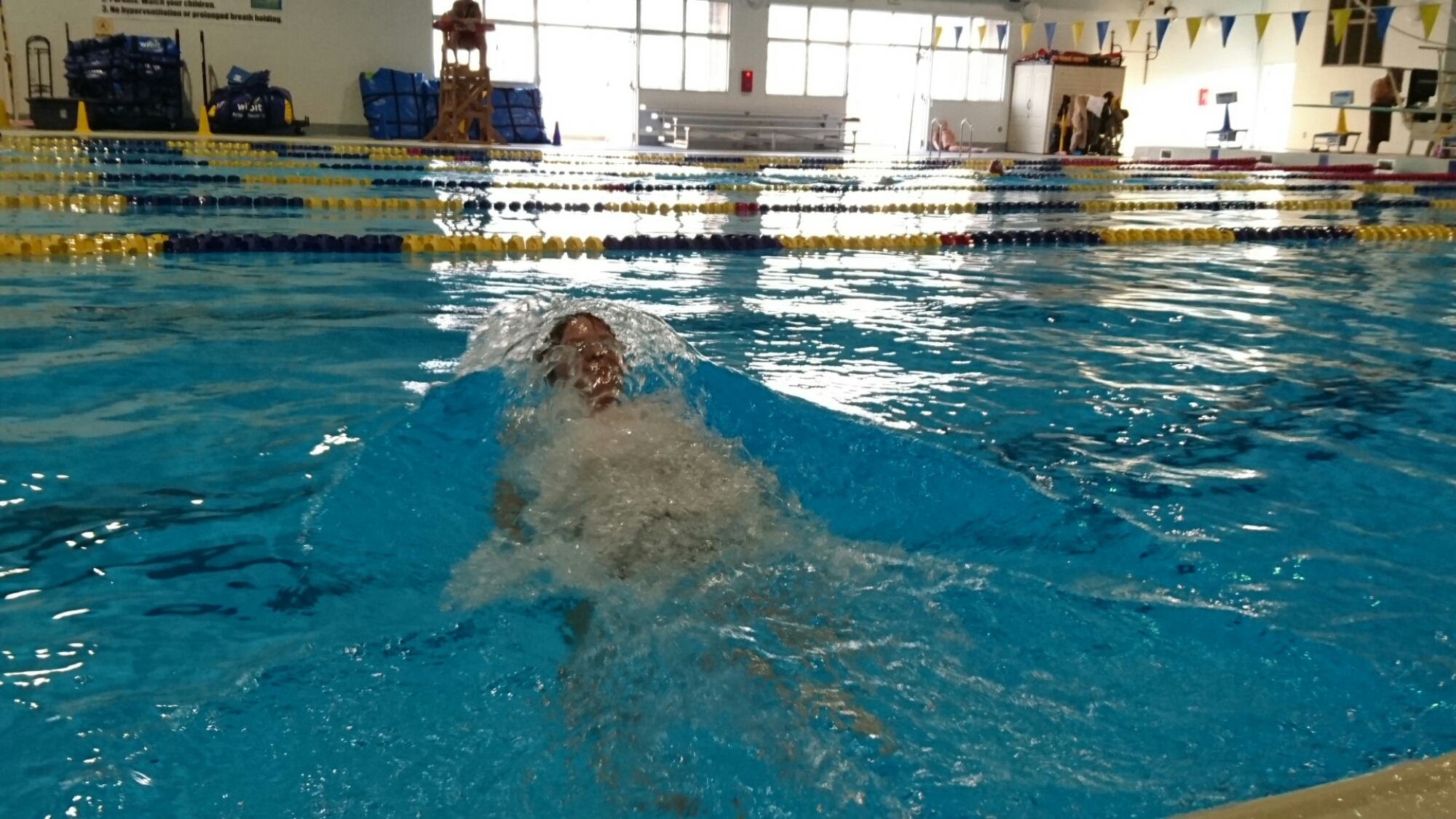
Pool time on Friday – Olympic size pool is on second story of the gym!

Walking to school

Coffee in a can from a vending machine got Dave and me through our area orientation brief last week. Passed the written driver’s test – behind the wheel is Friday!

Favorite ramen restaurant so far!

A walk in Mikasa Park after ramen.

My attempts today to find a stable for riding – Google translate in record mode was hilarious! I asked two stable hands for help and we stumbled along until I realized the microphone might help with a real-time translation service. It mostly did but we laughed a lot when we saw them say something about a “foreigner”! Mighta been “crazy gaijin”!
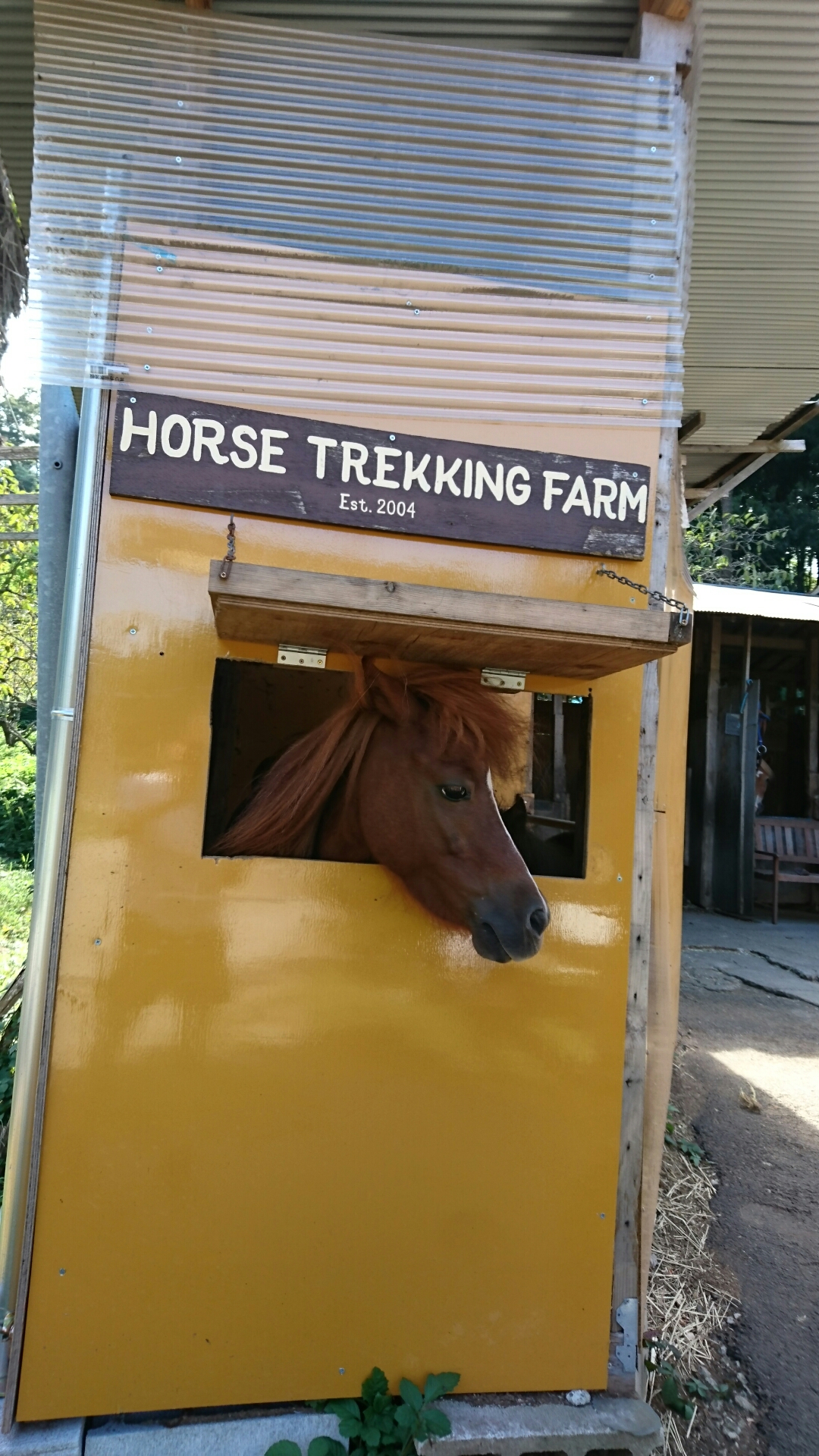
Perhaps a little small? Cute horses and beach riding option at this place. Would be fun once but pricey!

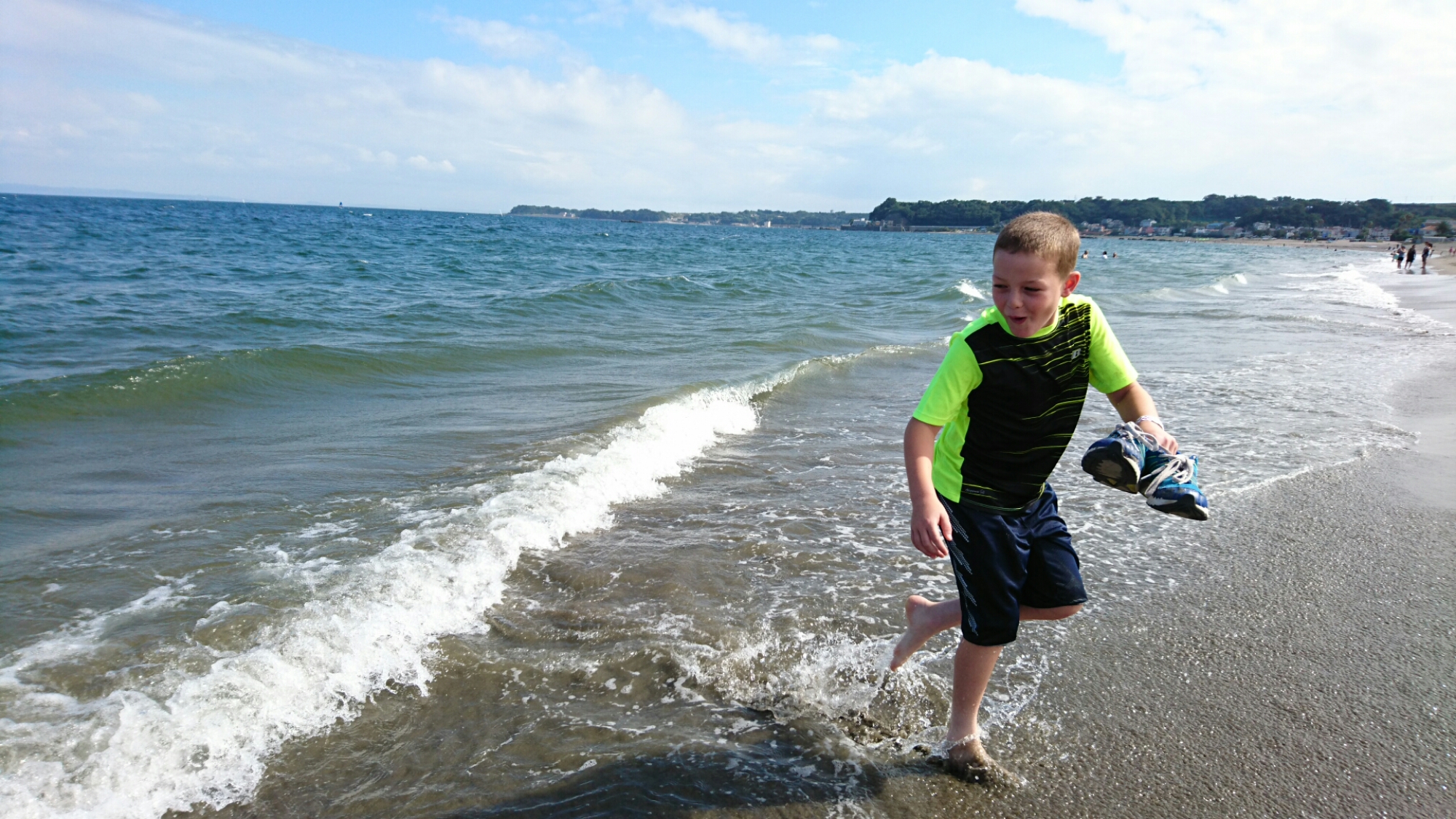
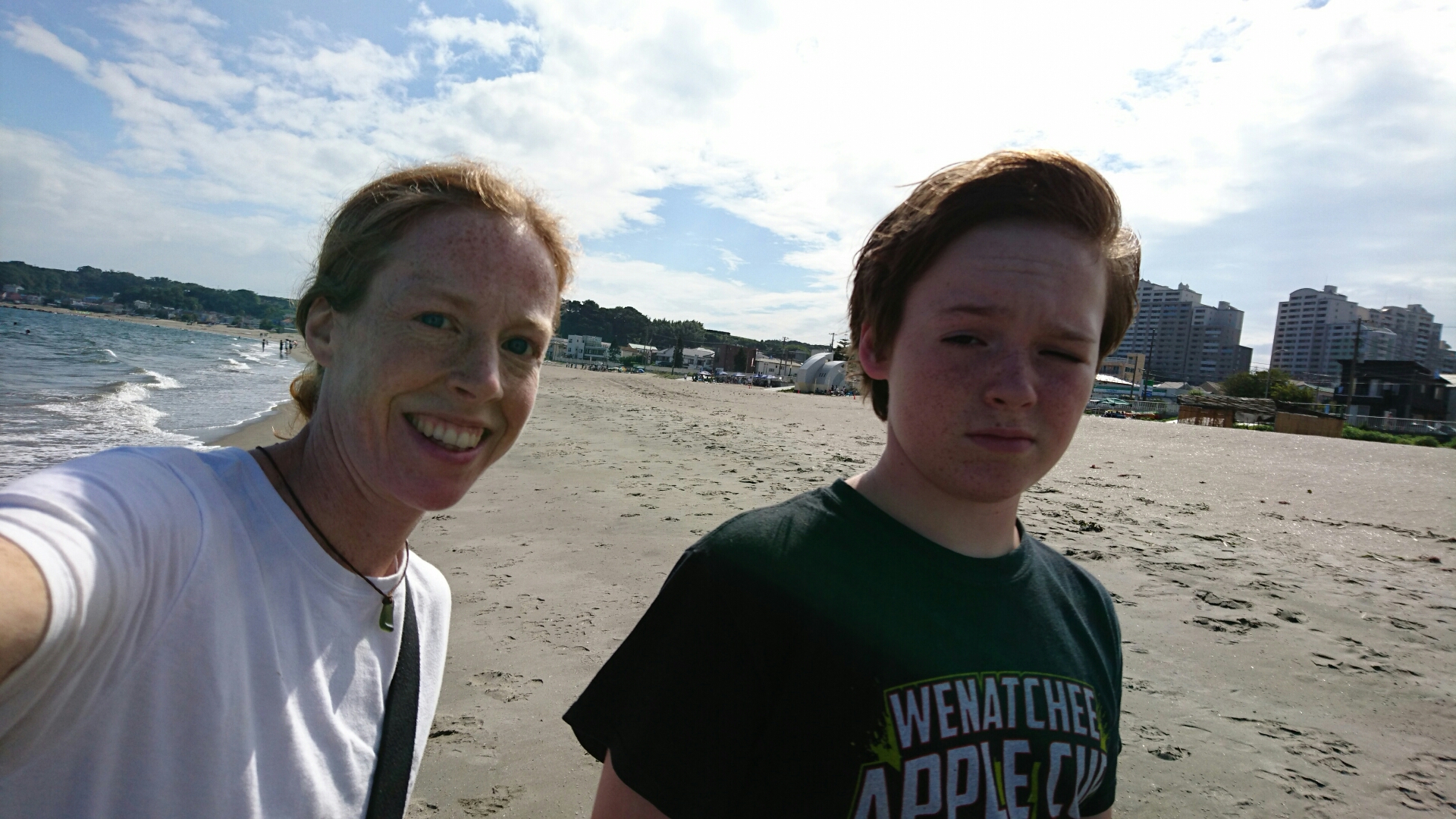
Miura Peninsula coastline. Warm water and very wide sandy beaches not crowded at all because it’s no longer considered “summer” here. Very season-conscious.
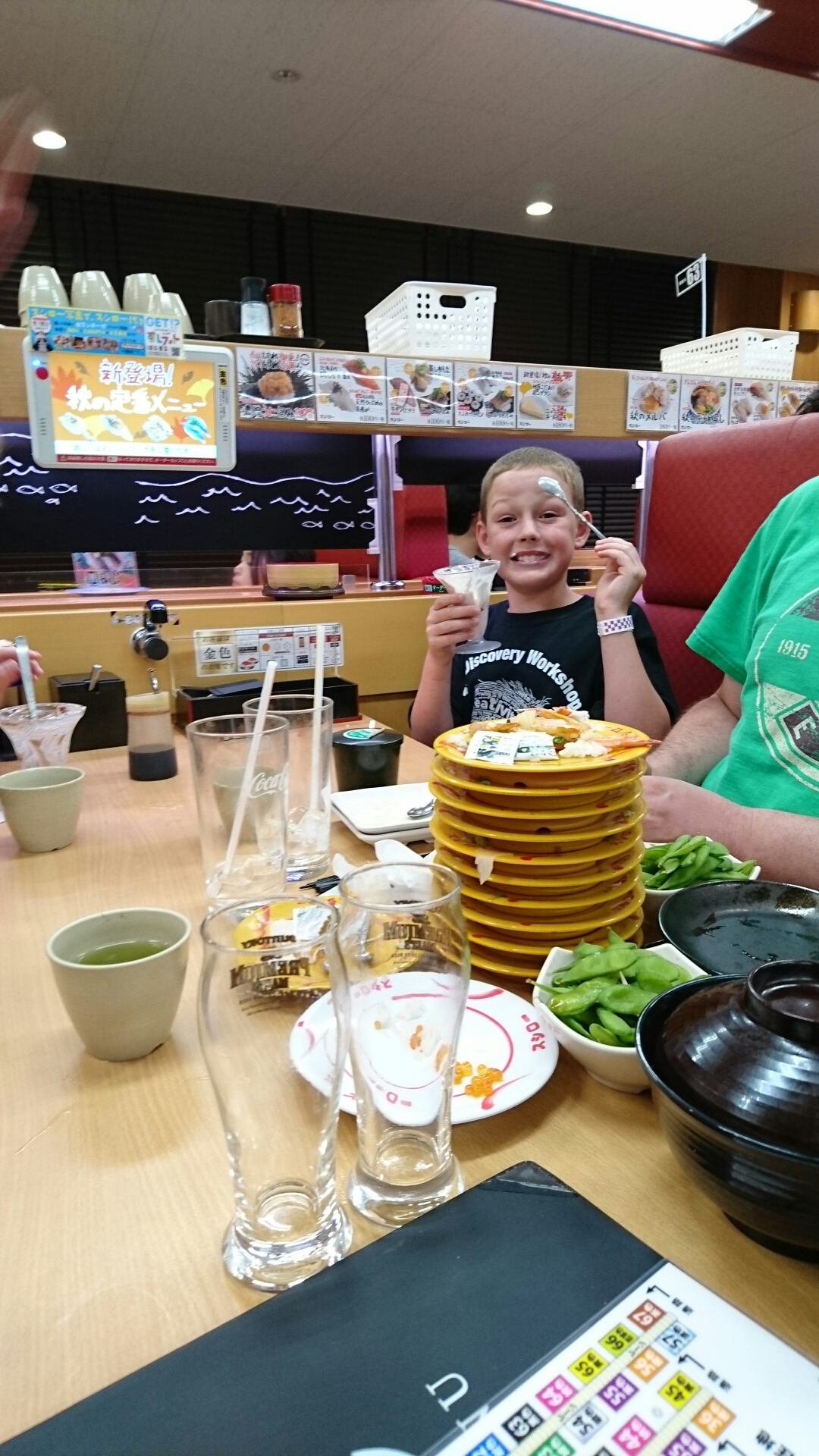
The kids love sushi delivered to your table on a conveyor belt!
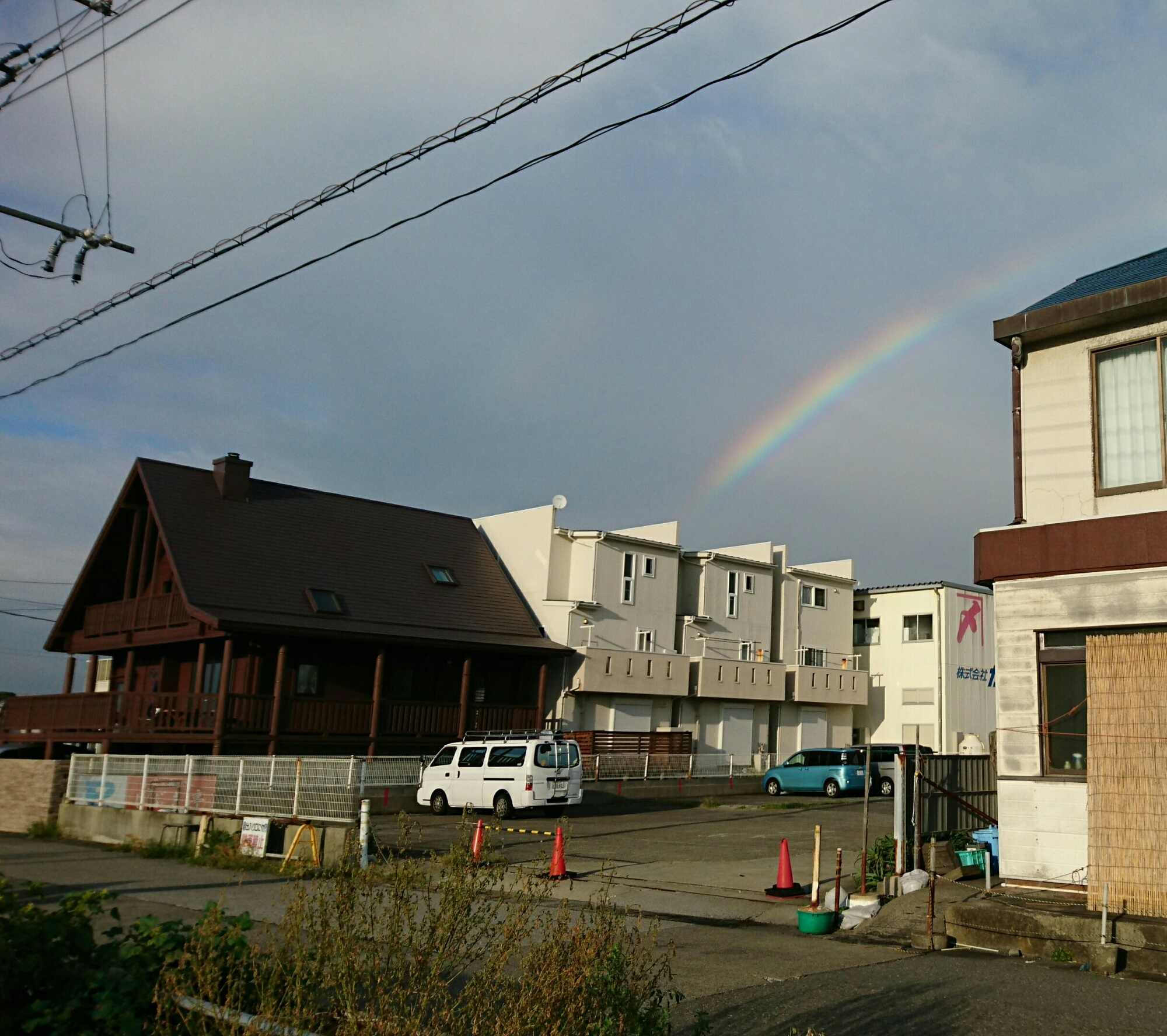
Our tour today ended with a double rainbow! “Oh dude?! Is that a double rainbow? What does it MEAN??? “
I need some SELF COUNSELING!
This is the term used to start your odyssey through the online household goods move application process used by the military. I ignored the silly name at first but after three phone calls to tech support, a browser switch, and some unintelligible acronyms for the location where we’re moving, I have decided I DO NEED SOME COUNSELING! It took 90 min to complete the process of requesting a bid for moving our household goods (HHG) during the week we need to be packed out. I still have to venture back into the website to request our non-temporary storage (NTS – the stuff we need to keep here and NOT ship to Japan) and our unaccompanied baggage (UB).
I haven’t had time to access either counseling or more online form fun because work intervened. One of my clients has been waiting a long time for me to review, reformat, proof and submit a manuscript. She lives in Kazakhstan so this morning I was able to confer on a few final questions just before she went to bed, then tonight she was waking up and thus we were able to close the loop and hit SUBMIT – but Dave was trying to get me to unplug. In vain.
In the meantime, while she was sleeping, I went to Fort Ward to serve as one of the first WAVES (Women Accepted for Volunteer Emergency Service) in 1942 for the living history tour of Fort Ward. I had the great privilege of “serving” with CDR Lee (Sarah) and Petty Officer Doherty (Christina) today at Station S – the top secret code school and listening post on the Parade Grounds at Fort Ward. A sell-out crowd of 63 people took a walking tour with energetic docents of all ages – from high schoolers to retirees. We had several young students dive right into period garb to act as kids playing baseball and a Coast Artillery Guard from 1910. In Station S, Sarah had period typewriters set up just as they were used by the radiomen. One for receiving messages, then another on the other side for you to turn to quickly and start transcribing the next message while someone grabbed the papers off the first one.
We had a great time staying in character despite inadvertent attempts to trip us up. It was so much fun – we all want to do it again, and thankfully people on the tour were already asking about the next date! One group of teens was apparently overheard saying “Wow, that was reeeeally cool! Total wormhole to 1942!”
I am also busy corresponding with potential tenants (our house just listed on Sat) and transitioning volunteer work to new leaders. I might also add that the flock management has not simplified. In addition to the 8 cute chicks who are assimilating so well into the larger flock, I have 2 month-olds which were incubated in the dining room and imprinted on me. So when I’m around, and they can hear me on the phone or doing laundry or WHATEVER, they start PEEEEPING loudly. They want attention from ME! Isn’t that soooo cute? It totally is. But honestly I could have picked better timing. The boys take the birds out for recess, but they’re getting harder to catch. Thankfully the boys are also getting quite good at doing their own laundry and sweeping up food bits from under the dining table. I’m having to delegate chores frequently because the multi-tasking has gotten more complicated. In the coop I have a full long-term-care facility going on. I have the 8 peeps in a heaving chick pile in one nesting box at night (if you disturb them, they all inflate like a pillow catching air, then when they calm down again, they all deflate at once); the next box down is Calvin the injured rooster who has cellulitis of his leg due to getting a toenail torn off somehow (I’m treating him three times a day with antibiotic after unsuccessfully treating with a human topical antibiotic); and in the 4th box down I have Wheat who has decided to go broody! Her chicks should pip out on July 5. Calvin is doing ok after about 10 days. I am not convinced he’s in decline, but his toe is very dark and his leg is swollen. I carry him in and out of the coop, put him in a quiet and private place with food and water and clean litter near enough to the hens so he doesn’t feel emasculated, but still safe from marauding coyotes and covered with a snow saucer for the occasional INSANE hail storms which have come through lately.
Here are a couple pictures of the zoo here. I am very much looking forward to my dear friend Molly coming for a visit on Wednesday as she and her family transit through the area!!! What will she think…probably will not be surprised 😉
The last 48 hours:

Calvin and his hurt foot – bandaged up in hockey tape 🙂

Me and my buddies from Station S!

Calvin in his safe little spot.

Crazy hail storm!

Saturday morning 9am hockey game! That means getting to the rink at 0800 to DRY IT OUT when it has been damp! I brought JetBoil to make coffee. This is one of my intrepid parents. It ended up raining anyway, after all that drying 🙁

I’m just a little behind packaging up eggs to sell.

Ben takes the two incubated babies (a month old) out for recess after school. That’s King Sam II on the left and Millet on the right.

8 cute chicks resting after a busy morning 😉
88-degree-hike calls for: lemon meringue ice cream!!!
Thanks to generous friends giving Sam an incredible night and day today, we were able to sneak away with Ben for a hike. I usually get to roust the family for a Mother’s Day hike but I think roller hockey games were scheduled for that day…so Dave suggested hitting the hills today. Good call – but it was HOT!
Here’s a run-down of Sam’s incredible 24 hours first, though: dinner with friends last night; sleepover with other friends; blueberry pancakes, hang-out time, hockey game, hat trick; pool time, and Hammy’s burgers! OMG!!!! All day I was feeling a bit badly for pawning him off, and thinking of him sweating it out with a 1pm game at the rink. I was texting another mom to make him drink water (I swear – I’m not a helicopter parent! ha!) and now I know he had plenty of breaks, drank 10 gallons of water, and enjoyed himself immensely luxuriating at the pool… what a day. Who would want to come home to boring parents after that? I can’t wait for school tmo. He is not enamored anyway…and after a Sunday like this? So help me.
As for Ben, Dave and me – we got a bit of a late start due to Hood Canal bridge closures, two in a row, so we did Mt. Walker for a warm-up hike. The rhodies were in peak form, though, so it was a great climb for a hot day. Fairly short but steep enough to feel a burn. We hit ice cream afterwards. I have never indulged before, but lemon meringue? On an 88 degree day? I could NOT resist. Here are a couple pictures of the day.

The wild rhodies were at peak bloom toward the summit!

Photo bomber!

South view point – you can see all the way to Seattle.

Lemon meringue is REALLY good. Ben got sherbet, too. He was talking about ice cream all the way down the mountain 🙂
Regarding move prep, things are progressing pretty well. We hope to hear about medical clearance this week. I dropped off all the records last week after visiting dental with the boys for a quick peek in the mouth. They checked out ok, as did I. Then they were spoiled with a BROWNIE at the dental clinic staff’s special lunch event…imagine their luck? A brownie at the dentist? From there we went to the Naval Hospital for medical records, and a Japanese encephalitis vaccine. I was keeping that bit on the down-low because (as you may recall, Richard) they tend to not so much enjoy shots. I went to get mine and the boys started asking the nurse what I was doing. She explained the shot, and why we get it, and how serious it can be (I’m listening the whole time, my jaw dropping more and more as I can hear them engaged with her) and get this: they came around the divider and ASKED IF THEY COULD GET THE SHOT!!!!! I was so nearly moved to tears by this. It was quite the Navy medicine day. I filled out two compliment cards – one at dental and one at medical. Everyone was so friendly, efficient, thorough and helpful. You don’t have appointments to do this, you have to just walk in, records in hand, explain what it’s for, and hope they can drop everything and see you, which they did. Unreal. From there Subway for lunch (Mom – no ordering issues this time!) and then to PORTLAND for a roller hockey tournament over Memorial Day. This is why it’s been quiet here…no time to jot things down.
Work continues. Volunteering is wrapping up at the schools, and I’m trying hard to find people to fill my shoes for Math Coach (I think I found someone great!) and Coder Dojo. It’s a tremendous group of people who donate their time to the schools. I’m lucky to know them. And I’ll miss working with them, but I already know which leadership teams I hope to join in Yokosuka…we shall see. The middle school is 606 kids 6th-8th, elementary 1700 K-5th. The base is 579 acres, and the population is 24,500 – not sure if that’s how many live on base or includes residents and workers. I’ll find out soon enough, but it sounds cramped.
This week we need to nail down government passports and how much we should rent the house for. We also really need to start laying out piles of donate/trash/sell. Not Dave’s favorite thing. Nor am I permitted to do that myself…so…tiptoe into that shall I. 😉
Lastly, were you wondering about chick mania 2.0? Everyone is doing well. The teens are out with the big chickens but have a separate eating area that the big ones haven’t figured out how to penetrate (I have studied the mind of the chicken and am not sure I should be proud to say this, but I am one with the chicken brain. I know their ways.) I watch them while lifting weights sometimes to see how they operate. I’m watching them, they’re watching me (usually it’s “happy hour” and they’re calm, preening). Odd, perhaps, but if you’re going to enjoy being a naturalist, you might as well be a strong, fit one. Takes nothing to do lunges with weights while watching the birds as neighbors run by and yell out a “HEEEY ALLI!” The smallest babies, the two which I incubated, are also doing well, but they are not as brilliant. They are not figuring out roosting very quickly. I put sticks in the hutch instead of plastic poles. Maybe they want a more authentic experience. Ben took them out to watch a BBC program on dinosaurs on his kindle so they could get outside time, AND he could chillax after hiking. They were mesmerized, little dinosaurs that they are. Scary that birds can be sucked in, too. They didn’t much like the spooky music documentaries employ to amp up the drama, so they moved on in a minute or two. I’m very relieved all the extra chickens are doing well integrating. That could have been a VERY high-maintenance proposition precisely when it would have been not so helpful. The teens are probably, at this moment, nearly 9pm, finding their way into the big coop and squeezing into their Japanese sleeping room in a nesting box. I created a little sliding door so they can sleep and wake without being harassed. Actually…I need to go open that door. I closed it for the day…yikes!
Love to all! Family – we will call sometime soon. I promise. Your best bet is to come visit, though. Seriously. Do. We love you! Friends – come visit, too! Molly – are you in town this week???? On your way to a wedding??? Grand Forest calls you!

Ben is a party boy!
Today was a big day – First Communion for Ben and his 8th birthday! We decided to do both on the same day (WHAT!?) so that he could celebrate his actual birthday. Somewhat thankfully his roller hockey game got rained out this morning (game and church within an hour!). I was at the rink at 0800 to figure out if we were calling the games or not due to rain…then home…take care of chicks…dress and head to church.
Disjointed post alert…this is one of the reasons I fall behind in posting anything here because so much happens in 48 hours, not to mention a week or two. Can you handle the off-road style post bouncing all over the place such that the seatbelt locks in place, pinning you down? Here we go…
Chicks – have I posted yet all the chicks hatching out here? I don’t think so – I have chicks coming out of my ears! I timed eggs to hatch on Ben’s bday so the incubator has been “cooking” them for 21 days. It is so exciting to candle eggs and see a little beak or foot moving. Two days ago the first chicks started pipping! We could hear them peeping from within the egg. Now we have two little cuties from our flock to add to the 8 that I bought in my chick mania a few weeks ago. In the garage hutch I have a “loft” for the newest ones closer to the heat lamp, and the other 8 are wandering around underneath. It is crowded, but I have a plan to re-home some…because…you know, there’s just no good intro for this: we’re moving to JAPAN at the end of August. We just found out a week ago that Dave was selected to transfer. We’re excited for the adventure and often heartbroken to leave our friends. This past week has been very busy beginning the overseas transfer process, starting with medical screening, collecting medical records and filling out forms.
Back to the chicks, though…I got into a chick mania because Dave said no to goats, and now I have too many birds!
Here is a movie of the chick hatching fun… Gordon (our rooster) joined our flock 4 years ago on Ben’s birthday, so it just seemed time for a new batch of fun…
Ok – so chicks started hatching out on Thursday (one arrived a day early) and another yesterday. Today we had 8 boys over for Ben’s party. I set up a chick hockey rink so they could all see the chicks and learn how to pick them up, and the chicks could get a look at boys. I am not sure who was more excited! There was lots of flapping and shrieking all around, such that I had to really be emphatic with the boys about not scaring the chicks so much. They were flying straight up into the air – about 4 ft up! It was nuts! Everyone had fun learning how to catch the little buggers. Ben and I realized chicks just don’t tend to back up, so if you kind of block them from the front you can gently catch them.
Here are some pictures from the day. I also tried to make a hockey puck cake. And because it was cold, and because I have been despondent about not being able to split wood or have a real fire in Japan, I had a FIRE, too. Gordon and all the big chickens came out for the party as well, and ran amuck all over. Ben and his buddies ran around the woods with hockey sticks, whacking weeds (which was good) and also managed to whack a mole (isn’t that kids’ game?) or a mouse and knocked it senseless. Poor thing. Lots of excited boys here. Every time I turned around it was something new. Only one Nerf bullet to the eye, and that boy will be ok. No one got hurt on the slack line or the zipline. Parents had a good time around the fire, eating some nice appetizers that Dave brought home. It was a great mix of hockey parents and school friends.


A chick in the incubator – the egg behind is pipping!

Ben and his First Communion class

The hutch with the bigger chicks, and the “loft” with the two newest ones. I love this little bird in the front. She is SO precocious! Always greets me at the door. Very very curious. The first one to climb on top of the loft, too. I cut a screen off a dead fan and put a ceiling in to keep the curious one from marauding the littlest sibling.

The chick hockey rink – one got away!

Sam (an ice hockey buddy) caught a chick!

Enjoying catching a buddy named “Julian” 🙂

J and his namesake.

Stack of hockey pucks…valiant attempt. Tasted good!
Niiiice 🙂

Poor mouse…or mole? Or vole?

Jayne and me – she is another hockey mom. Four boys who play!
Dear Ben,
Happy 8th birthday, sweet boy, full of life and energy. I am so thankful to be your mom, and share this wild life with you. If it weren’t for you, Dear Ben, who would run around the market with me playing bumper cars with sour cream in hand? Who would giggle over silly games? Who would go for jogs and bike rides? Who would beat me up a mountain? And who would help guard baby chicks who need some recess and outside time? And split wood? And we haven’t even talked about ice hockey and roller hockey…you are an animal on skates with a great wrister. You love working on your shot at home, scaring the little chicks with all that loud whacking on the shooting tiles.
You also love reading very much and your favorite books right now are the Warriors series about a cat family. Your friend J loaned a book to you and you couldn’t put it down. You’re also very excited to build StarWars Millennium Falcon and a Creator Corner Deli.
How is school going? your grandparents are probably wondering…well, your teacher has been working with me all year to help you manage exuberant outbursts, but this week you managed to have a “zero” week as I called it. I knew you could go FOUR DAYS with ZERO reminders, and you DID! You’re an ace student, too, who pays attention to detail, does his homework expeditiously, and has an excellent brain with fabulous recall for details. Stunning recall, actually. And I regret mentioning this, but you’re a debater with a razor-sharp retort that is always accurate because it hip-checked nuance right out of the way 😉
Most importantly, you’re a loving and kind boy who is usually the first to notice I could use a hug. How you bundle all this loud boy energy into a body that is also sensitive enough to notice how another person is feeling, I don’t know. I cherish you.
I love you, Ben.
Mom
A day with Emmy
I’m so thankful to have this dear grey mare in my life. Saturday was a very busy day – starting out with our first roller hockey games (I’m a coach now! and thrilled!) then a soaking in the rain packing up gear, then 6 boys at our house, and hungry, then off to find some Magic cards which were accidentally thrown out (so headfirst in a trash bin) then back home, throw breeches and boots on…and head to warm Emmy up. But it’s RAINING again…so…here’s the whole story. The backstory first? Yes?
Training Level 1, 1st test Thanks to Janet (my instructor) for filming this and for bringing me so far in 2.5 years!
Emmy and I enjoyed a bit of a wild warm-up at home (rain on the arena roof, which must sound like jaguar claws to her or something) so she was pretty hot and full of energy even after warm-up. On the way to the show via the trails through the woods she was quite intrigued by rain on the leaves and how the woods sound in the rain (different than normal). Once in the warm-up arena she had no real desire to canter through the muck, nor did she want to canter on the rail (where there is a decent path and no muck), so she picked the next best option – try to leap 20 yards of muck! The woman coaching her client in the middle of the warm-up arena must have had some second thoughts, but she stayed put hoping I could steer this beast.
Janet arrived shortly after and held a constant refrain: “MORE bending! more LEG! FORWARD! Get her to pay ATTENTION!” Eventually we settled in a bit, and I thought the walk from the warm-up ring to the arena might go smoothly. JUST as we were walking by a van with a horse in it, the horse inside decided to let fly with a large bang on the rear door. Emmy spun wildly to the right launching me forward in the direction we WERE going, then wheeled (by the bed of a pickup, which I thought might be a nice clean landing spot if I got thrown) but by this time she was cantering and I was still barely mounted, so determined to stay on, and keep my white shirt clean. I steered her toward a cedar tree to induce a stop, got her turned around again just in time to see Janet turn back toward us, arms outstretched, going “What’s the hold up? Come ON!”
Once she was in the dressage “court” Emmy performed fabulously, not even “talking” to the other horses around like she did last year. You’ll note one effort to gallop away from the judges’ stand at “C” at the left end of the arena but I got her back under control and just barely transitioned to a trot and made the final tight turn down the center line. I wonder what my scores will be? The whole event was great to look forward to – an excellent motivation for focus and a good opportunity to keep Emmy familiar with the unfamiliar. Life should NOT always be groundhog day, should it? Thanks for watching! (This is the second half of the test. The first half is a mirror image.)
Mother’s Day!
Dear Mom!
Did you know you still have a daughter? I know it has been ages since I have called or written anything more than 3 words! Are you still reading this? I am so so so sorry to have been OFF THE GRID lately! How long has it been? Sooooo sorry. Geez. It’s Mother’s Day! Time to share what is going on around here, but it will be brief because guess what…I have practice plans to print for roller hockey and eat dinner because I’m STARVING! First, though, I’d like to say what an inspiration you are for being energetic and loving to those around you every day! I am so lucky to have you as a role model for investment in the kids. I love you!
We have chicks in a rabbit hutch donated by a friend…because Dave won’t let me get a goat or two. I have plans, though…on that front. If you board goats for a neighbor, they’re not REEEAAALLY your goats, right? Richard…fencing. Think fencing. Yes. Dave doesn’t read this. I don’t think.
Dave is so very thankful I didn’t make good on my goat-adopting plans that he didn’t even PEEP about the incubator set up on the credenza by our dining table with 7 eggs in it, incubating for Ben’s 8th birthday, just like we did 4 years ago. I think he’s happy I’m in a chick-hoarding mania instead of just two goats. He may find that two goats is preferable. He seemed a little mystified at the energies exerted to herd 8 baby chicks in the tall grass while I cleaned out their brooder, but Ben is very good at catching baby chicks (Sam prefers herding them with hockey sticks) and got them right back into the paper shopping bag to carry back to the brooder when I had it cleaned, which was, of course, just minutes before leaving for the rink to skate. Picture Ben with a paper shopping bag, twitching and cheeping in his hand as he carried it into the garage. Picture Dave standing in his socks, watching and wondering. I often drive around, thinking about things, and something Dave said recently – “Oh, there’s no managing her.” I wonder if this is what makes him think crazy things like that? It’s all under control…I’m sure that’s evident, right??? 😉
Baby chick catching strategy: after some study, I noticed that chicks don’t back up. Their first instinct is to run. So catch from the front and they’ll run into your hands. Then just lock down the little chick-cage you’ve created with your fingers. Once this is accomplished, be sure you have their wings pinned down and don’t let them get leverage with their little feet. Then you can safely carry them. Once, Ben thought a chick pooped on his hand and he dropped the poor little thing. I have concussion diagnosis training now thanks to hockey, but the little chick seemed fine. Nevertheless, I named her Helmut (as in, Kohl). She continues to make expected progress…

Ben is a good chicken herder. They get to go on “hikes” out in the grass with him!

Sometimes chicken guarding is exhausting. One needs to take a little break 🙂
The roller hockey team is very small (7 kids, 4 of them entirely new to roller hockey) so my mission is to make it fun to learn the game AND learn to skate, incidentally. I have two very able assistants (teen coaches) so I try to keep the big picture, develop practice plans to provide structure, work with corralling (some are very young and escape the rink to go flop around) and morale. Team spirit – yes, I can do that! Enthusiasm and strong female role model for our girl players – yes, I can do that! I love skating and love the game of hockey, so I am very very happy to have this opportunity. Dave is reviewing my practice plans and telling me if he can hear me contribute anything from across the rink during games 😉 I’m still finding my voice as a coach. I’m an ardent and NOT SHY fan…but coach voice? That should be developed intentionally.

Second practice – in sneakers because a light rain had made the rink surface waaay too slippery. That’s ok – very easy to learning passing skills in sneakers!

First scrimmages! hot hot day, then to a dressage clinic for me. Exhausting 😉 But fun!
I also lead a Coder Dojo club at the intermediate school to provide those kids interested in coding a social group and mentoring opportunities. I have had a lot of fun with this even if I feel very underqualified. I have terrific mentors from the community (two tech folks who donate their time) and we have at least a dozen committed kids who enthusiastically develop programs each week in free sites available on the web. We provide encouragement, challenge, and direction. And from time to time, CUPCAKES for developing a game based on a group-decided theme! (I.e., must be interactive and include cupcakes, a unicorn or a horse, and a happy ending!)

Coder Dojo guest speaker – Mr. Roas presents how his company improves product development efficiencies with customized apps. The kids learned what it takes to develop a concept through design, sourcing, manufacturing, and delivery. It was terrific! (I launched and lead the club on Thursdays at the intermediate school.)
Now it’s Sunday, Mother’s Day. I “slept in” to 7. The above things are all from the last 48 hours.

This morning I rode in a dressage clinic again (they are three days long) and then took Emmy on a trail ride. We rode around in the warm-up ring because I have a show next weekend (AGAIN right after a roller hockey game!) and while cantering my phone flew out. She tried to kick it on its way down into the sand. Pretty funny. So while I was off retrieving it, I decided it was time for a selfie. Emmy hates selfies. She was in the middle of rubbing her head on me and knocking me over. Thankfully I am very accustomed to being shoved – Sam likes to throw me around!
Before going to skate over at the roller rink with all three boys (Dave included) for our Mother’s Day outing, the boys and I tidied and cleaned the house (it looks great now!) and had a wrestling session. They don’t like to hug anymore so I lured them into our bedroom and got Ben onto the bed so I could really hug and wrestle him. Sam came in and saved him from me, and I foolishly tried to get Sam onto the bed so I could smoosh him and wrestle him, too. That went on for some time. We are a dead match now. If I can get my horse-riding legs around him, he’s sunk. But, I can’t quite do that anymore. He gets away quickly and is a terrible force to be reckoned with, especially if I’m in socks and he has sneakers on…on the wood floor…which was the case. I was handicapped. I will come back to this…
Off to play some hockey…then home for pizza. While waiting for pizza I decided to address the chicks’ naughty habit of putting their cedar shavings into their waterer, making for soggy shavings and a tough time getting water. It looked like such a nice, cushy place until they spread the shavings all over. (This was the boys’ idea – they should have shavings, not newspaper. Seemed reasonable. Seemed like Mother’s Day would be a nice day to make their nest even better.) Anyway – I got the hamster waterer from the grown-up chicken coop and cleaned it, then wired it up to the rabbit hutch. I thought it would at least be interesting for them, and perhaps make my life easier. Watch…how long does it take chicks to figure out how to use a waterer? I started filming about 10 min into the adventure.
Happy Mother’s Day, all you moms! Thank you for reading this tribute to the life force we all bring to the homefront. I love you, Molly, Tam Tam, Rebecca, Jenni…and of course my own mom, and my cousins, Leslie and Deborah! (I just got a note from Leslie – my cousins are alive! And actually read this post!!!!! Turns out they are frenetic, too!)

I know I know…JUST when you thought it couldn’t get ANY better…I went out to close the coop (the BIG birds, the college dorm) I found EIGHT eggs – ALL 8 layers LAID! This happened ONCE before. On the vernal equinox. Amazing, right? Here they are! And guess what else? One of the older babies was ROOSTING tonight for the first time on his little maple branch in the hutch, under his warm red heat lamp! When I went out to check, there he was, ROOSTING like a big boy! (Not all is bliss…the garage door wouldn’t go down all the way. Ben had knocked the emergency brake thing so that it wouldn’t close but it took three people 3 minutes to figure this out.) Lest you think it’s all cheep cheep cheep here…I did growl at that because I was the janitor at the time (doing recycling and kitchen clean-up) and simply wanted to close the darn door! 😉
Hanford


 The boys and I are in Richland WA with Dave to see the reactor compartment of his first submarine, the EX-Birmingham, be laid to rest In the desert. Enroute, I stopped at the Kittitas County Museum in Ellensburg because I read they had a rock collection. The boys also really enjoyed seeing an antique car collection because they know something about Ford and his Model T’s. When Sam saw Ellensburg blue agates he mumbled “uhg Maaahwm, why don’t you sign me up for these sorts of things more? ” I asked at the desk of sky landowners have fee dig sites and got a name! I called and got no answer. Figured it could be run by an old timer so called again and reached the husband who said “ah well I don’t get into Bernice’s things so here’s her number.” Found Bernice still at the dig site and told her we were coming straight away! We picked up gas, Gatorade and snacks (never know what you’re getting into rock hounding!) and headed 30 min north into the hills. After a briefing about agate formation (Ellensburg blue agates are the only agates to be considered precious, made blue, it is thought, by calcidium), and how to interact with a guard llama (look like a human, not a dog, so she doesn’t attack you) and kicking horses (don’t dig in that pasture!), we were off. It was so fun to see the boys light up. We hunted along the stream so we could wash the agates off – came away with probably two pounds of agates, a few with blue stripes. Also found petrified wood and jasper. We finally tore ourselves away, vowing to return soon (“Monday, mom?!”). 2hrs further to Richland and the pool!
Then to the port where the submarine was being offloaded drum the barge it had traveled on all the way from Bremerton, down the coast and up the Columbia River.These trucks are ENORMOUS! Ben took off on a run to catch up with them. I think Dave is glad I’m a runner, too 😉 The “package” Is being towed out to the desert. Takes 6 hours because they travel so slowly. Sam says the package weighs 1500 tons. The truck it sits on has 21 rows of 24 wheels! I ran 7 miles on the very nice bike path up the river while the boys played in the pool. Tomorrow a tour of B Reactor.
Excursion
Took the boys on a nice bike ride since we don’t have hockey this weekend. Just one more week – happy and sad about the end of the season. I think we’re all a little more worn out than we realize and the fridge is bare. But…I still love spending time on the ice. Five of us skated last night. Felt so good to skate hard and clear my end-of-season cold from my lungs! We didn’t get home until 10pm. Slept hard and enjoyed having a buddy over for Sam. Nice start to the weekend. Boys are playing cards while I make some gifts for the hockey team end of season party. Gotta get back to it! Dave is working on his last school paper of the term…

Telling the boys a story about bike-camping on a 1000km trip around Denmark 20 yrs ago during March. The weather was exactly like this - very windy. Imagine drying towels out in this weather? We woke up to find them frozen in the shape they hung from the tent poles. The tents weren't lightweight like backpacking tents today. And my mountain bike had broken so I was using a three speed tourist bike I rented from the train station. Soon the granny gear on that failed so I got quite a workout! But it was a lot of fun.

Sam loves to have his picture taken! Especially with me - ha!
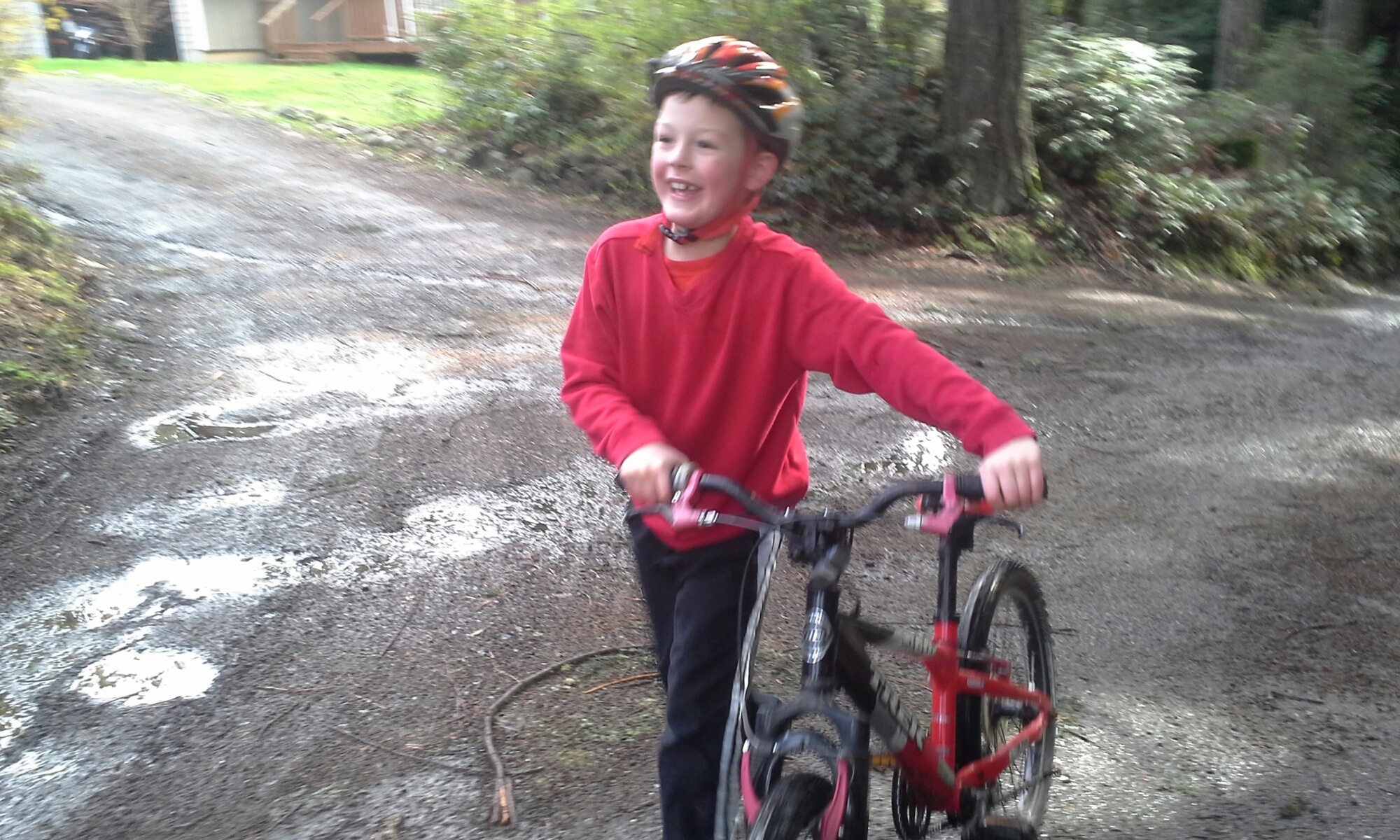

A little treat from the Jiffy. Fun time with the guys. We also enjoyed stopping for food in very small towns, eating bike-side. Imagine biking along a pasture with no fence and a herd of horses or cows stomps across the road right in front of you? The boys liked thinking about that-no "life-controller" parent to fence them in and make them do homework or go to bed. 😉
Hockey madness!
This weekend was going to be so manic that I knew I needed to prep Dave three weeks in advance. Hockey game for Ben in Tacoma at 10:20am (so that means leaving at 8:30am), game for Sam in Bremerton (2:15pm), mini game during a Juniors game (Thunderbirds – big arena, announcer, mascot, the whole deal) for Ben at night in Seattle, and then an 8:10am game for Sam in Lynnwood (6:25am ferry, 5am up). On top of that, two boys wouldn’t be able to play unless they got a sleepover with someone and a ride. SO! That only took two hours to convince Dave to add into the mix 😉 He took the Showare Arena run at night on Sat so I could host Sam and his two buddies. These two (cousins) have a LOT of energy. They rival Ben. They climb the steel beams at the rink. Or anything they can find. I promised them for every goal scored by our team (we were playing a tough team) that they could jump off Sam’s bunk. Well…the game was 8:1 (the other team won), but guess what the boys did? Yep. They added the goals and each jumped 9 TIMES off Sam’s bunk! I tried that last night. It’s a good workout climbing and jumping!
Here are some pictures of the events of the weekend…

It started Friday night with Mites practice. I did this stick drill, actually! Didn’t spaz! Ben is VERY fast going through these.

Ben riding down to Tacoma with me. We left Dave and Sam at home to chill a bit then meet us in Bremerton.

Our goalie got hurt, so this is Jaydyn gearing up. He’s one of the boys I got to keep Sat night.

Here’s Alex at the card store (first stop after the game) admiring a strategy game about to start.

This is evidence of boy entertainment…check out the movie below. We were blowing up soda bottles with dry ice…

Dawn at the rink. Pretty sky. I’m arriving at a hockey game 1.5 hours away BEFORE DAWN!

Ferry time! It’s 6:25am now. Hi, coaches! We love these guys. They are all hockey dads – boys on the team.

This is how they build good teams: 9 coaches on the ice with young girls of all ages, BEFORE DAWN!

Sam and Ben got hair cuts today! I tried to get a picture but after giving them dessert and then romping with them, this is what you get – hip checks and mischief!

I paid Ben $5 to do all the laundry – get it out, sort, fold and put away. He did as well as I do! Dave said “that’s not hard” from across the house when I was in there marveling. Nuh uh! Not fair! Folding is not IMPORTANT! It just needs to be neat… harrumph!