getting the garden ready – composting is complicated
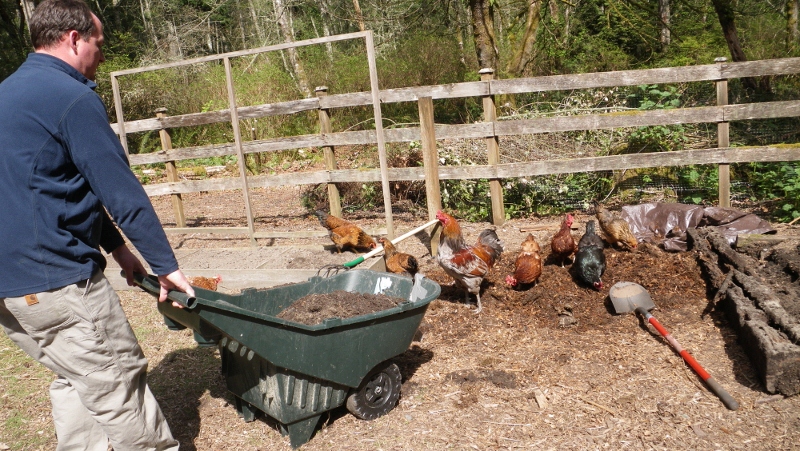
Dave getting some compost for the garden beds, and the chickens very happy to help out!
You’d think it would be very easy – dump manure and bedding into a pile, turn over, wait, and ba-da-bing, you’ve got black gold – high-nitrogen fertilizer for your garden.
Unfortunately, it’s a bit more complicated than it sounds, especially when you’re trying to compost fresh chicken manure which is reportedly among the highest N-containing manures. I apparently didn’t turn the compost enough, so it didn’t all turn into black gold. You have to really get three piles together in three stages – new stuff, medium stuff, old stuff. It takes 4-5 months for the compost to turn into soil. If you harvest it too early, the N will be off the charts, you’ll burn your plants, and potentially contaminate them with E. coli or salmonella.
Today I bought a compost thermometer to make sure the inside core gets to 160+ to kill weed seeds and pathogens. And I’ve got multiple piles going. And I’m studying the nitrogen cycle along with Sam. Did you know that plants can’t use atmospheric nitrogen (N2)? Some plants (legumes) have a friendly bacteria (Rhizobium) which can convert N2 into NH3 which the plants can use. This is why cover crops planted over the winter are so helpful. Chicken manure and coffee grounds are also very effective in replenishing N. Our beds were pretty good with respect to P and K, according to my soil testing last week. Cross your fingers this amateur gardener can get her act together and grow something which doesn’t sicken the family. I plan to grow stuff with goes UP in the contaminated bed – tomatoes, peas? Any other ideas?